
japanese-university-admission-interview
Japanese University Admission Interview: Common Questions and How to Answer (for International Students)
In a Japanese university admission interview, the panel mainly wants to know three things: why you want to study this subject in Japan at this school, whether your Japanese and academic ability are enough to follow the classes, and what you will do after graduating. Most questions are variations on those themes, and many are asked straight from your statement of purpose, so your spoken answers must match what you wrote. Interviews for Japanese-taught programmes are held in Japanese, and can be in person, online or, at some schools, in your home country.
- Interviews are common. JASSO’s Student Guide to Japan lists the interview among the usual parts of entrance exams for international students, alongside document screening, academic tests, a short essay, the EJU and the JLPT. Its EJU guide describes the flow as document screening first, then an interview and the entrance exam.
- The rules require them for some routes. Japan’s education ministry (MEXT) requires an interview, which can include a presentation, group discussion or oral exam and can be held online, in comprehensive selection (sōgōgata senbatsu) and, with a limited exception, in school-recommendation selection, starting with the 2027 entry year.
- Genuine intent to study is checked. For privately funded international students, MEXT tells schools to judge whether applicants truly aim to study and have the ability, motivation and aptitude to do so. For classes taught in Japanese, it names level B2 or above on Japan’s Reference Framework for Japanese Language Education (based on the CEFR) as the benchmark.
- Some schools interview abroad or online. Around 200 schools use pre-arrival admission with the EJU, and some hold interviews in applicants’ home countries.
Common questions, in five groups
The table shows the questions you are most likely to hear, in the Japanese that panels use. The first group decides most interviews.
| Group | Typical questions (Japanese / English) | What the panel is checking |
|---|---|---|
| 1. Reasons | なぜ日本に留学したいのですか (Why study in Japan?) なぜ本学を志望したのですか (Why this school?) なぜこの学部・学科なのですか (Why this faculty or department?) |
A real, specific purpose. JASSO’s guide says entrance exams look at whether students are focused on their goal in the field they chose. |
| 2. Study plan | 入学後に何を学びたいですか (What do you want to study?) どのゼミや研究に興味がありますか (Which seminar or research interests you?) |
That you know the curriculum and the faculty’s strengths. |
| 3. Background and ability | 高校でいちばん力を入れたことは何ですか (What did you work hardest on at school?) 日本語はどのように勉強しましたか (How did you study Japanese?) 得意な科目と苦手な科目は (Best and weakest subjects?) |
Academic and Japanese ability to cope with classes, and how you learn. |
| 4. Future | 卒業後はどうしたいですか (What will you do after graduating?) 将来の夢は何ですか (What is your goal?) |
That the degree fits a believable plan. |
| 5. Life in Japan | 学費や生活費はどうしますか (How will you pay tuition and living costs?) ほかの学校も受験していますか (Are you applying elsewhere?) 日本での生活に慣れましたか (Have you settled into life in Japan?) |
That you can study without financial or practical problems, and how serious your application is. |
Questions about who pays your tuition and whether you are sitting other exams are also listed by the international student portal ryugakuat.jp, so prepare honest, short answers to both.
The three admission routes and how the interview differs
| Route | Who uses it | What the interview is like |
|---|---|---|
| Entrance exam for privately funded international students (私費外国人留学生入試) | Most international applicants | Usually documents, the EJU or the school’s own tests, and an interview. The panel checks your purpose, Japanese and study plan. |
| Comprehensive selection (総合型選抜, formerly AO) | Applicants who apply on their own initiative, often with a strong activity record | MEXT describes detailed document review combined with a careful, longer interview, and requires the applicant’s own documents (activity report, statement of purpose, study plan) to be used. Expect presentations, discussions or oral questions on your field. |
| School-recommendation selection (学校推薦型選抜) | Applicants recommended by their high school principal, usually at schools in Japan | Based on the school report and recommendation, with an interview on your motivation and aptitude. |
Why memorised answers fail
Panels rarely stop at the first answer. They ask “why?” until they reach something you have not prepared, and they compare what you say with your statement of purpose. Three patterns invite follow-up questions:
- A general reason. “Japan has advanced technology” leads to “Which technology? Why not study it in your own country?”
- A claim without an example. “I am interested in environmental engineering” leads to “What have you read or done about it?”
- A gap between the essay and the answer. If your written plan mentions a professor’s research and you cannot explain it, the panel notices.
The same problem appears in job interview practice. In Crystal Method’s AI interview practice tool (Japanese-language sessions from 26 June to 11 October 2026, scored automatically by AI), about 53% of improvement points were about missing specifics and about 10% about not explaining the reason behind an answer. The data comes from job interview practice, not admissions, but the weakness is the same.
Example answers
Written for this guide; replace every detail with your own. Prepare a short version (about 30 seconds) and a longer one (about a minute) of each, because some panels ask you to keep it brief and others ask you to say more. Use polite desu/masu Japanese throughout and avoid casual fillers such as うん or そうそう.
| Weak answer | Why it fails |
|---|---|
| 「親に勧められたからです」 (My parents recommended it.) | No purpose of your own. |
| 「友達が日本にいるからです」 (I have friends in Japan.) | A reason to visit, not to study. |
| 「第一志望の国に行けなかったからです」 (I could not go to my first-choice country.) | Tells the panel Japan is second best. |
| 「有名な大学だからです」 (Because it is famous.) | Says nothing about the subject or the department. |
| 「アルバイトで全部払います」 (I will pay everything by working.) | Suggests work will come before study. |
なぜ日本に留学したいのですか (Why study in Japan?)
Weak: 「日本の文化が好きで、日本に住んでみたいからです」 (“Because I like Japanese culture and want to live in Japan.”)
Stronger: 「日本の防災工学を学びたいからです。私の国では洪水の被害が多く、日本の河川の堤防や避難の仕組みを本で知りました。日本で学んだことを、将来、母国の防災計画に生かしたいと考えています」
“Because I want to study disaster-prevention engineering. My country suffers frequent floods, and I read about Japan’s river levees and evacuation systems. I want to use what I learn here in disaster planning in my home country.”
なぜ本学を志望したのですか (Why this school?)
「貴学の工学部には河川工学の研究室があり、実際の河川で観測を行っていると知ったからです。オープンキャンパスの模擬授業で〇〇先生の講義を聞き、観測データから堤防の弱い場所を見つける方法に興味を持ちました」
“Because your engineering faculty has a river engineering lab that does field measurements on real rivers. At an open-campus trial lecture by Professor ___, I became interested in how they find weak points in levees from observation data.”
In an interview, the school you are applying to is often called 貴学 (kigaku) or 御校 (onkō); either is acceptable if you are consistent.
自己紹介をしてください (Introduce yourself)
「〇〇から参りました〇〇と申します。現在、東京の日本語学校で1年半日本語を勉強しています。高校では数学と物理が得意で、学校の科学コンテストで地域の防災マップを作りました。本日はよろしくお願いいたします」
“My name is ___ and I am from ___. I have been studying Japanese at a language school in Tokyo for a year and a half. At high school my best subjects were maths and physics, and for a school science contest I made a disaster map of my area. Thank you for seeing me today.”
Keep it to about a minute: name and where you are from, what you are doing now, one thing connected to the subject you are applying for.
日本語はどのように勉強しましたか (How did you learn Japanese?)
「高校2年生から独学で始め、来日後は日本語学校で毎日4時間授業を受けています。授業の外では、ニュースを毎日1本読んで要約しています。専門の言葉はまだ足りないので、入学までに理科の教科書を日本語で読み直すつもりです」
“I started on my own in my second year of high school, and since coming to Japan I have had four hours of classes a day at a language school. Outside class I read and summarise one news article every day. My technical vocabulary is still limited, so before entering I plan to reread science textbooks in Japanese.”
Be honest about your level and show how you are improving; a JLPT certificate alone does not prove you can follow lectures.
長所と短所 (Strengths and weaknesses)
「長所は、新しい環境に早く慣れることです。来日して3か月で、アルバイト先の仕事を一人で任されるようになりました。短所は、分からないことをそのままにしがちなことです。今は、その日のうちに先生や友人に質問するようにしています」
“My strength is adapting quickly to new places: within three months of arriving I was trusted to handle my part-time job alone. My weakness is leaving questions unanswered, so now I ask a teacher or friend the same day.”
学費や生活費はどうしますか (How will you pay?)
Weak: 「アルバイトで全部払います」 (“I will pay everything from my part-time job.”) This suggests work will come before study.
Stronger: 「学費は両親が負担し、生活費の一部は週20時間以内のアルバイトでまかないます。奨学金にも応募する予定です」 (“My parents will pay the tuition, and I will cover part of my living costs with a part-time job of no more than 20 hours a week. I also plan to apply for scholarships.”)
International students on a Student visa need permission for part-time work, within 28 hours a week (up to eight hours a day in long holidays), according to JASSO’s Student Guide to Japan. Check the current rules before you answer.
ほかの学校も受験していますか (Other applications?)
「はい、同じ分野の学科がある〇〇大学も受験します。ただ、河川の観測ができる研究室があるのはこちらだけなので、第一志望です」 (“Yes, I am also applying to ___, which has the same field. But only your school has a lab doing river observation, so you are my first choice.”)
Answer honestly; panels know applicants sit several exams. Saying “this is my first choice” only works if you can say why.
入学後に何を学びたいですか (Study plan)
「1年生では数学と力学の基礎を固め、3年生から河川工学のゼミに入りたいです。卒業研究では、観測データを使って洪水の危険を予測する方法に取り組みたいと考えています」 (“In my first year I want to build a base in maths and mechanics, and join the river engineering seminar from my third year. For my graduation research I want to work on predicting flood risk from observation data.”)
卒業後はどうしたいですか (After graduating?)
「まず日本の建設コンサルタント会社で数年働き、実務を学びたいです。その後、母国の公共事業に関わり、日本で学んだ技術を広めたいと考えています」
“First I want to work for a few years at a construction consultancy in Japan to learn the practice, then work on public projects in my home country and spread what I learned in Japan.”
Interviews at language schools and vocational schools
Many international students apply first to a Japanese language school, then to a professional training college (senmon gakkō) or university. The interviews are shorter but follow the same logic:
- Japanese language schools: JASSO’s Student Guide says most decide admission by screening documents, but some interview applicants and their guardians or set a written test. Expect questions on why you want to learn Japanese, what you will do after the course, and who will support you financially. Some schools interview overseas or online.
- Professional training colleges: the entrance exam can include document screening, a subject test, an interview, a short essay, an aptitude or practical test and a Japanese test. According to JASSO, it mainly checks whether you are focused on the field you chose, whether your Japanese and academic skills are enough for the classes, and whether you really want to study. Link your answers to the job you want after graduating.
- Graduate schools: selection is mainly by documents, but some add an interview, usually on your research plan.
Manners on the day
- Clothes: wear your school uniform if you have one; otherwise a plain suit or neat, dark, simple clothes. Avoid casual wear even for online interviews.
- Entering: knock, wait for どうぞ (dōzo), say 失礼します (shitsurei shimasu), bow, and give your name and examinee number when asked. Sit when invited.
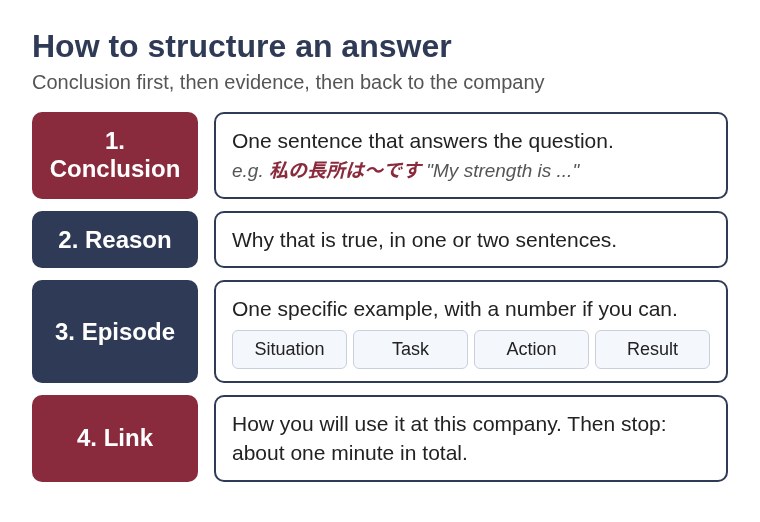
- Answering: start with the conclusion, speak a little slowly, and look at the person asking. If you do not understand, say 「恐れ入りますが、もう一度お願いいたします」 (“Sorry, could you say that again?”). Asking is better than guessing.
- Online: camera at eye level, a plain background, and log in a few minutes early to test sound.
- Group interviews: listen when others speak and keep your answers short.
Check your answers yourself in three steps
- Record yourself on a phone answering the five groups of questions, and watch it as if you were the panel. Is the conclusion in the first sentence? Can you understand it without your notes?
- Ask “why?” three times after each answer and answer out loud. Where you get stuck is where the panel will push.
- Compare with your statement of purpose. Mark every claim in your written statement and check that you can explain each one in spoken Japanese.
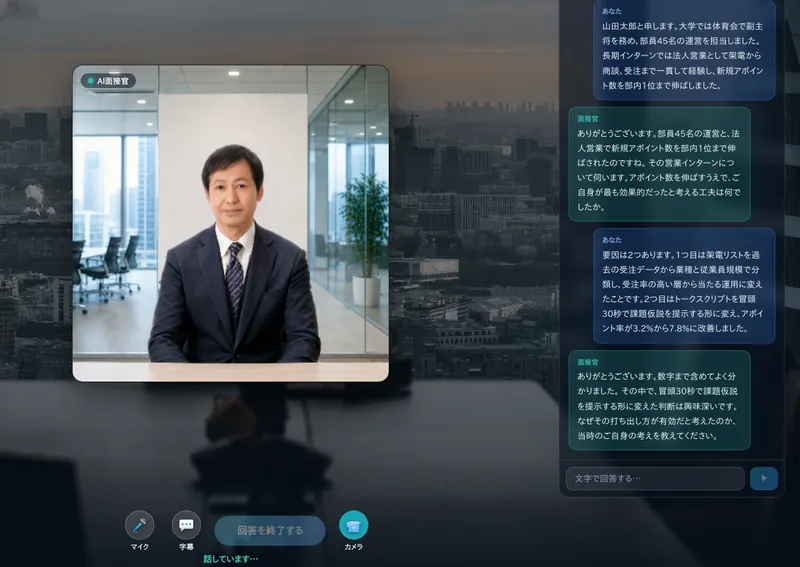
For speaking practice with follow-up questions, Crystal Method’s AI interview practice tool runs an interview with an AI interviewer and gives feedback. It is built for job interviews and is in Japanese only, so it is most useful for practising Japanese answers to the “why” questions.
FAQ
What questions are asked in a Japanese university admission interview?
Mostly why you want to study in Japan, why this school and department, what you want to study, how you studied Japanese, what you did at school, how you will pay for your studies, and what you will do after graduating. Many are asked directly from your statement of purpose.
Is the interview in Japanese or English?
For Japanese-taught programmes, usually Japanese. English-taught degree programmes usually interview in English. Check each school’s application guidelines (募集要項).
How long is the admission interview?
It varies by school and route, and there is no national standard. Comprehensive selection tends to involve a longer, more detailed interview and may add a presentation or discussion. Check the format in each school’s application guidelines.
What level of Japanese do I need?
It depends on the programme. For classes taught in Japanese, MEXT names level B2 or above on Japan’s Reference Framework for Japanese language education as the benchmark schools should make clear.
Can I do the interview from outside Japan?
Often, yes. MEXT allows online interviews in its selection rules, around 200 schools offer pre-arrival admission with the EJU, and some hold interviews in applicants’ home countries. Check each school’s guidelines.
What should I ask if they ask whether I have questions?
Ask about study, not rules you could read online: for example, how first-year students choose a seminar, or what support exists for international students who want to join research early.
Sources
- MEXT: Implementation guidelines for university entrance selection, 2027 entry (令和9年度大学入学者選抜実施要項) (Japanese). Comprehensive and school-recommendation selection, required interviews, admission of privately funded international students and the B2 benchmark.
- JASSO / Study in Japan: Student Guide to Japan 2026-2027 (English PDF) and EJU Guide (English PDF). Entrance exam components, admission flow, pre-arrival admission.
- Ryugaku@JP: Interview test advice for international students. Common question topics.
- Crystal Method AI interview practice tool: usage data from 26 June to 11 October 2026 (Japanese-language job interview practice, automatic AI scoring). Percentages only; not limited to foreign users and not admission interviews.
For job interviews after graduation, see the guide to Japanese job interviews and how to do a mock interview in Japan.
Practise answering “why” questions in Japanese
The AI interview practice tool is in Japanese only and is free to try: AI interview practice tool (Japanese).
Supervised by
河合 継, CEO, Crystal Method
An AI researcher and the inventor on 16 patents related to AI and deep learning, with past joint research with the National Cancer Center Japan and AI commentary on Japanese TV programmes. Leads AI research and development at Crystal Method.
About the company (Japanese) | Editorial policy (Japanese)
This page is general information about studying in Japan. Admission rules differ by school; always check the official application guidelines. Last reviewed: 21 October 2026.
Study about AI
AIについて学ぶ
-

PHP脆弱性へのAIセキュリティ対策——中小企業・自治体担当者の実務ガイド
2026年10月21日、PHPに重大な脆弱性2件が確認され、国内の多数のサービスが予防的なサービス停止を余儀なくされた。システム担当者にとって他人事ではない。P...
-

面接のロールプレイング(ロープレ)とは?選考で出る課題の流れと、練習のやり方
面接のロールプレイング(面接ロープレ)とは?まず結論から 面接のロールプレイング(面接ロープレ)は、主に2つの意味で使われます(面接をする側の練習として行うこと...
-

MiniMax M3.1 Flashでできること——機能・使いどころ・注意点を解説
MiniMax M3.1 Flashは、テキスト・画像・動画を入力として受け付け、100万トークンのコンテキストウィンドウと常時オンの推論機能を備えた大規模言語...