
japanese-job-interview
Japanese Job Interviews Explained: What to Expect, How They Work, and How to Prepare
A Japanese job interview follows a set pattern: you are usually interviewed several times by different people, the interviewer works from the application form (entry sheet) and resume you submitted, and they judge your motivation, how you present yourself, and whether you will fit the company, as well as your Japanese. Manners are part of the assessment from the moment you arrive at reception. If you know the format in advance and practise short, specific answers, most of the “Japanese interview is different” problems disappear.
- Several rounds: companies usually interview you more than once (first, second, final), often with different interviewers each time.
- Your documents drive the questions: interviewers read from your entry sheet and resume, so your answers must match what you wrote.
- Japanese level matters: JASSO’s job hunting guide reports that about 70% of companies want business-intermediate Japanese or higher at the job-offer stage, and about 90% after joining.
- New-graduate timetable: the government asks companies to start publicity from 1 March of the year before graduation, screening (interviews) from 1 June, and official job offers from 1 October. Many companies also hire all year round.
- Arrive early: JASSO advises arriving at the venue 15 minutes before the set time, and logging in 5 minutes early for an online interview.
What is a Japanese job interview like?
In Japan the interview is the most important part of selection, but it rarely stands alone. It sits inside a longer process that starts with written documents and often includes tests. Three features make it feel different from interviews in many other countries:
For foreign applicants there is one more layer: the interviewer is also checking whether you can understand questions and explain yourself in Japanese. JASSO notes that companies assess writing through the application form, and listening and speaking in the interview.
How the hiring process works in Japan
The order below is the typical path for a new graduate. Mid-career hiring has no fixed season and the steps vary by company, but the interview stages look similar.
| Stage | What happens |
|---|---|
| 1. Pre-entry | You register interest on a job site or the company website to receive information. |
| 2. Company briefing | A session (in person or online) explaining the business, jobs and selection steps. |
| 3. Entry sheet and resume | Your self-promotion and reasons for applying in writing. Used to decide who gets an interview. |
| 4. Written or aptitude test | General knowledge and aptitude tests. JASSO notes these are taken in Japanese, which many international students find hard. |
| 5. Interviews | Usually two or more rounds: group discussion or group interview early, one-on-one interviews later, then a final interview. |
| 6. Job offer | An informal offer (naitei), usually by phone, then a written offer. You may be asked to sign a pledge. |
| 7. Status of residence | If you are a student, you must change from “College Student” to a working status before you start. JASSO advises finishing this by the end of January to start on 1 April. |
Types of interview you may face
| Format | Typical stage | What to focus on |
|---|---|---|
| Group discussion (4 to 6 applicants) | First round | How you work with others: listening, building on ideas, keeping time. |
| Group interview (2 to 6 applicants) | First and second rounds | Short answers to the same questions everyone gets. Have a one-minute self-introduction ready. |
| One-on-one interview | Second to final rounds | Deeper questions on your documents, strengths and how serious you are about this company. |
| Online interview | Any round | Camera at eye level, speak a little louder, nod visibly. Interviewers notice if you read notes. |
| Recorded video (1 to 2 minutes) | Often the first screen | Self-promotion, what you focused on as a student, or why you are applying, said clearly within the time. |
What Japanese interviewers look for
Interviewers want to hear, in your own words, why you are applying, what your strengths are, and what you think. They also check that your answers match your documents and that you can say it briefly. In practice this comes down to a few things:
- Clear motivation: why this industry, why this company, and for international students, why Japan.
- Specific evidence: a real episode with what you did, how you thought, and what changed, rather than a list of adjectives.
- Consistency: the same story across the entry sheet, resume and every interview round.
- Commitment: JASSO’s list of typical questions includes “How long do you plan to stay or work in Japan?” Companies want to know you will stay.
- Japanese communication: understanding the question and answering it directly, politely and concisely.
Specificity is where most people fall short. In Crystal Method’s AI interview practice tool (Japanese-language sessions from 26 June to 11 October 2026, scored automatically by AI), about 53% of all improvement points the AI gave were about a lack of specifics such as concrete episodes or numbers. The next most common were not explaining the reason behind an answer (about 10%) and a hard-to-follow structure (about 9%).
The core questions and how to answer them
Most interviews combine a few standard questions with questions aimed at foreign applicants. The examples below are written for this guide (they are not real candidates’ answers). Each one gives the conclusion first, then a specific episode, then the link to the company. Japanese is shown first, with an English translation.
| Question | What they want to know | How to answer |
|---|---|---|
| 自己紹介をお願いします Please introduce yourself |
Can you summarise yourself clearly in about a minute? | Name, school or current job, one thing you worked hard on, one line on why you applied. |
| 志望動機を教えてください Why do you want to join us? |
Why this company and not a competitor? | What you want to do, the experience behind it, and what only this company offers. |
| あなたの長所と短所は何ですか Strengths and weaknesses? |
Self-awareness, and whether the strength is useful in this job. | One strength with an episode; one real weakness with what you are doing about it. |
| 5年後、どうなっていたいですか Where do you see yourself in five years? |
Will you stay, and does your goal fit their career paths? | A goal you can reach inside this company, tied to its business. |
| なぜ日本で働きたいのですか Why do you want to work in Japan? |
Is your reason for Japan serious and long-term? | Link your past, the work you want to do in Japan and your future plan. |
Self-introduction example
「〇〇大学経済学部4年の〇〇と申します。大学では物流のゼミで、配送ルートの改善を研究しました。アルバイト先の倉庫では、出荷ミスを減らすために確認表を作り、チームで使ってもらいました。本日はよろしくお願いいたします。」
“My name is ___, a fourth-year economics student at ___ University. In my seminar I studied how to improve delivery routes. At the warehouse where I work part-time, I made a checklist to reduce shipping errors, and my team now uses it. Thank you for meeting me today.”
Reason-for-applying example (conclusion, episode, company)
「私が御社を志望するのは、日本と東南アジアをつなぐ物流の仕事がしたいからです。大阪の物流会社でアルバイトをした際、配送時間を細かく計画する仕組みに驚きました。御社は東南アジア向けの輸送に力を入れているため、その計画の力を学び、将来は母国との取引を広げたいと考えています。」
“I want to join your company because I want to work in logistics that connects Japan and Southeast Asia. Working part-time at a logistics company in Osaka, I was struck by how precisely delivery times are planned. Your company is expanding shipping to Southeast Asia, so I want to learn that planning here and later grow trade with my home country.”
Strength example (with a number)
「私の長所は、課題を数字で確かめて改善できることです。倉庫のアルバイトで出荷ミスが月に10件ほどあったため、確認表を作ってチームで使ったところ、3か月で月2件まで減りました。」
“My strength is that I check problems with numbers and fix them. At my part-time warehouse job we had about ten shipping errors a month, so I made a checklist for the team, and within three months it fell to two a month.”
Five-year goal example
「5年後には、御社の東南アジア向け物流の担当として、現地の取引先と日本の工場の間の調整を任される人材になりたいです。そのために、最初の数年は国内の配送計画の基本をしっかり身につけたいと考えています。」
“In five years I want to be trusted to coordinate between your partners in Southeast Asia and factories in Japan. To get there, I want to spend my first few years learning the basics of domestic delivery planning.”
Weakness example
「短所は、一人で抱え込みすぎるところです。ゼミの発表準備で締め切りに遅れそうになったことがあり、それ以来、作業を始める前に進め方をメンバーと共有するようにしています。」
“My weakness is that I try to do too much on my own. I once nearly missed a deadline preparing a seminar presentation, so since then I share my plan with the team before I start.”
If you are changing jobs, expect “Why are you leaving your current job?” (退職理由) and questions about any gap in your career. Give a forward-looking reason (“I want to work on X, which my current role does not offer”) rather than complaints about your employer, and explain a gap briefly and honestly (study, family, a move to Japan) with what you did during it.
Polite Japanese (keigo). You do not need perfect honorifics, but use the polite desu/masu form throughout, say 御社 (onsha) for “your company” when speaking, and use set phrases such as よろしくお願いいたします. Clear, polite and simple beats complex and wrong.
Talk about the team, and be clear about your part. Japanese interviewers tend to respond better to “our team cut errors, and my part was the checklist” than to a story where you did everything alone. Modesty is not hiding your role; it is placing it inside the group’s result.
For all 22 common questions with the Japanese wording and example answers, see Japanese job interview questions.
JASSO also lists questions that international students are often asked: How long do you plan to stay or work in Japan?, How would you feel if we could not place you in the department you want? and Have you used our products? What did you think? Prepare an honest answer to each.
Researching the company before the day
“What do you know about our company?” and “Do you have any questions for us?” both test your research. Before each interview, check:
- the company’s mission or philosophy (kigyō rinen) on its website;
- its main products or services, and who its customers are;
- recent news and press releases from the past year;
- for listed companies, the medium-term plan or investor relations pages;
- the job description, and any overseas business that connects to your background.
Use what you find in your reason for applying, and turn one point into a question for the end of the interview.
Interview etiquette on the day
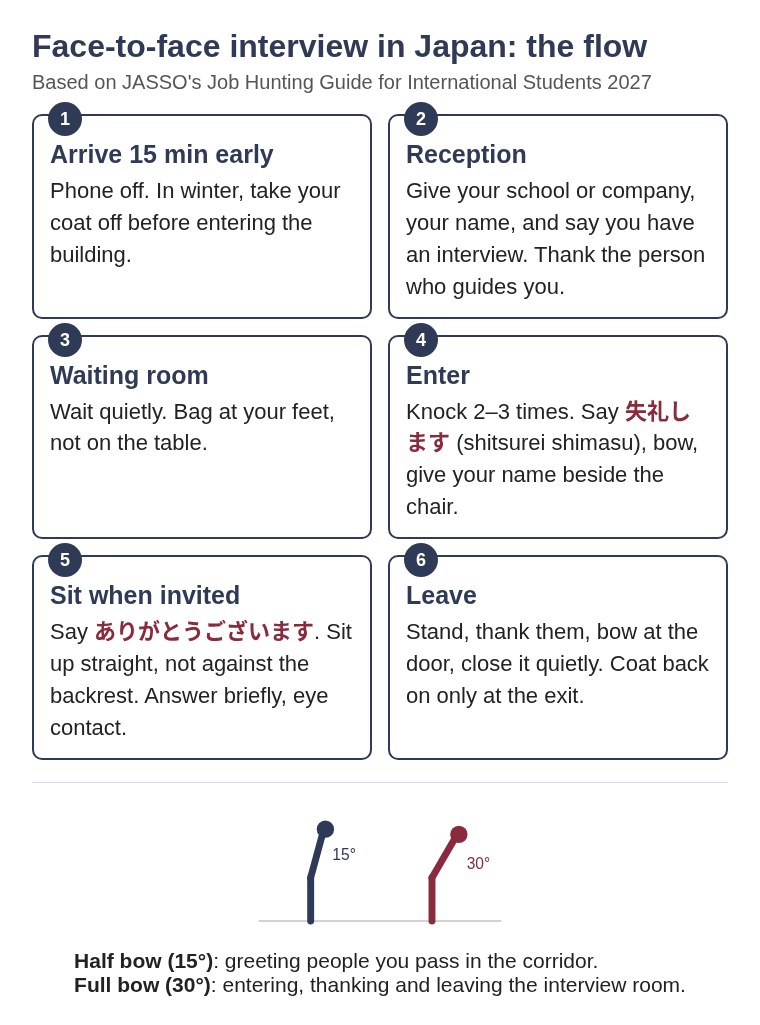
Treat the whole visit as part of the interview. JASSO’s guide describes this flow for a face-to-face interview:
- Arrive at the venue about 15 minutes early. Turn off your phone and, in winter, take off your coat before entering the building.
- At reception, give your school (or current company) and name and say you are here for an interview.
- Wait quietly, with your bag at your feet.
- Knock two or three times, say shitsurei shimasu (“excuse me”) when called, bow, and give your name beside the chair.
- Sit only when invited, without leaning back, and answer concisely while making eye contact.
- When it ends, stand, thank the interviewers, bow again at the door and leave quietly.
If a train delay makes you late, call the company before your scheduled time. For an online interview, log in five minutes early and leave the call only after the interviewer disconnects. For each step with the reasons behind it, polite phrases and a thank-you email example, see Japanese job interview etiquette.
What to wear
For most Japanese companies the safe choice is a plain dark suit, a white shirt or blouse, simple shoes and neat hair. New graduates often wear a “recruit suit” sold for job hunting. JASSO’s point is that clothing shows you take the interview seriously. Foreign-owned firms and start-ups can be more relaxed, but if the company has not said otherwise, dress formally, and dress the same way for an online interview. For checklists for men and women, how to read dress instructions in the invitation, and seasonal advice, see what to wear to a job interview in Japan.
Your self-introduction
Almost every interview opens with “please introduce yourself” (jiko shōkai o onegaishimasu). Keep it to about one minute: your name and school or current job, one or two things you have worked on, and one sentence on why you are here. This is different from jiko PR (self-promotion), where you argue your main strength with an episode. JASSO suggests having a one-minute description of your strengths ready for group interviews. For a one-minute template, phrases with readings and more example scripts, see Japanese self-introduction for job interviews.
How to practise before the real interview
JASSO recommends two kinds of practice: record yourself answering questions and check your eye contact, clarity and language, and ask a friend or your university’s career counsellor to run a mock interview. Free help is also available from the government:
- University career centre or international office: interview and resume advice, often mock interviews.
- Employment Service Centers for Foreigners (Tokyo, Osaka, Nagoya, Fukuoka): job information, counselling and placement for foreign nationals, with English support.
- Hello Work (public employment offices): employment counselling in every prefecture, with foreign-language phone support in all 47 and interpreters in some offices.
For where to book a mock interview and how to run one, see mock job interviews in Japan. If you are applying to a Japanese university rather than a job, see the university admission interview guide.
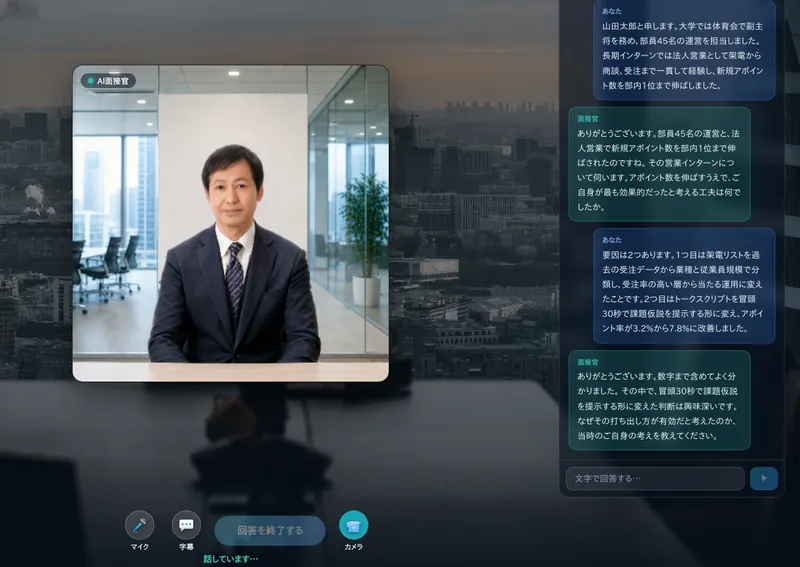
You can also practise alone with an AI interviewer. Crystal Method’s practice tool runs a mock interview with an AI interviewer that asks follow-up questions and then gives a score and feedback. The tool is in Japanese only (questions, voice and feedback), so it suits applicants who will be interviewed in Japanese.
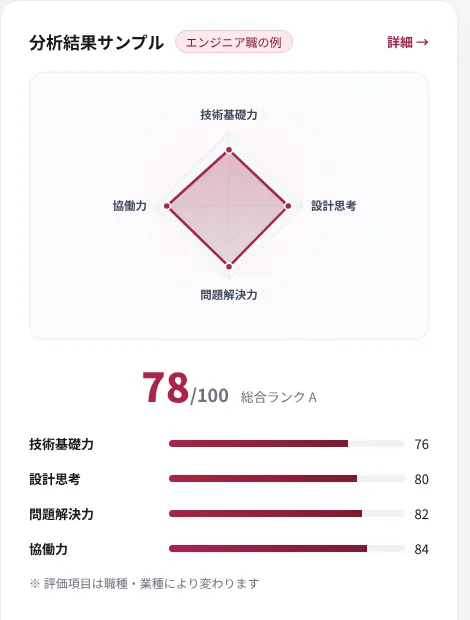
From the same usage data, completed sessions that ran 10 minutes or longer had a median overall score of 54.6, compared with 13 for sessions of 1 to 3 minutes. Practising a full-length interview, not just one or two questions, shows you where your answers run out of detail.
Questions employers should not ask
Japan’s Ministry of Health, Labour and Welfare (MHLW) asks employers to select applicants only on aptitude and ability. Its guidance lists 14 matters that can lead to discrimination if asked in an interview or on an application form, including:
- your registered domicile or birthplace;
- your family (their jobs, health, education, income or assets);
- your housing and home environment;
- your religion, political party, philosophy of life or “the person you respect most”;
- union membership, student or social movements, and which newspapers or books you read.
Some interviewers still ask. You can answer briefly and steer back to the job, and if a question worries you, the labour bureau or Hello Work can advise you.
Visa basics for job seekers
- International students must change their status of residence from “College Student” to one that permits work. JASSO reports that about 80% of students who changed status to work in 2023 moved to “Engineer/Specialist in Humanities/International Services”.
- When reviewing the change, the authorities look at whether your studies match the job, whether the pay is appropriate, and whether the company is stable.
- If you graduate without a job, you can apply for “Designated Activities” to keep job hunting: six months, renewable once, so one year in total.
Check the current rules with the Immigration Services Agency before you apply. This page is general information, not immigration advice.
Mistakes foreign applicants often make
- A vague reason for Japan. “I like Japanese culture” is not a reason to hire you. Connect Japan to the work you want to do.
- Answers that do not match the documents. Re-read your entry sheet before every round.
- Long answers. Give the conclusion first in one sentence, then the episode. Aim for about one minute.
- Adjectives without episodes. “I am hard-working” needs a situation, your action and the result.
- Avoiding the “how long will you stay” question. Have a sincere answer ready.
- Reading notes in an online interview. Interviewers can tell.
- Forgetting that reception counts. Greet staff and wait quietly.
- Not asking anything at the end. Prepare one or two questions about the work itself.
FAQ
How do I pass a job interview in Japan?
Prepare a clear reason for applying, link it to a specific episode from your experience, keep each answer to about a minute with the conclusion first, make sure every answer matches your entry sheet and resume, and follow basic manners from reception to leaving the room. Practise full-length mock interviews before the real one.
How hard is it for a foreigner to get a job in Japan?
It depends heavily on your Japanese and your field. JASSO reports that about 70% of companies want business-intermediate Japanese or higher at the job-offer stage. Jobs that use English or specialist skills, and companies that recruit all year, widen your options.
How early should I arrive for a Japanese interview?
JASSO advises arriving at the venue about 15 minutes before the appointed time and logging in about 5 minutes early for an online interview. If you will be late, phone the company before the start time.
How many interviews are there in Japan?
Usually more than one. A common pattern is a group stage first, then one or two one-on-one interviews, then a final interview. The number varies by company.
Are Japanese job interviews conducted in Japanese?
At most Japanese companies, yes. Foreign-owned companies and English-speaking roles may interview in English, sometimes with a Japanese round. Ask the recruiter in advance.
Do I have to sign a job offer pledge?
Companies often ask you to submit a pledge or acknowledgement after an offer. JASSO notes it is not legally binding, but you should decline other offers promptly and honestly once you decide.
Primary sources
- Japan Student Services Organization (JASSO): Job Hunting Guide for International Students 2027 (English PDF). Schedule rules, selection process, interview types and manners, typical questions, practice, support centres, status of residence.
- Tokyo Labour Bureau (MHLW): Fair recruitment and the 14 matters to consider in selection (Japanese)
- MHLW: Basics of fair recruitment selection (Japanese)
- Crystal Method AI interview practice tool: usage data from 26 June to 11 October 2026 (Japanese-language sessions, automatic AI scoring). Percentages only; the data is not limited to foreign users.
Practise a Japanese interview with an AI interviewer
The practice tool is in Japanese only and is free to try: AI interview practice tool (Japanese).
Supervised by
河合 継, CEO, Crystal Method
An AI researcher and the inventor on 16 patents related to AI and deep learning, with past joint research with the National Cancer Center Japan and AI commentary on Japanese TV programmes. Leads AI research and development at Crystal Method.
About the company (Japanese) | Editorial policy (Japanese)
This page is general information about job hunting in Japan. Last reviewed: 21 October 2026.
Study about AI
AIについて学ぶ
-

PHP脆弱性へのAIセキュリティ対策——中小企業・自治体担当者の実務ガイド
2026年10月21日、PHPに重大な脆弱性2件が確認され、国内の多数のサービスが予防的なサービス停止を余儀なくされた。システム担当者にとって他人事ではない。P...
-

面接のロールプレイング(ロープレ)とは?選考で出る課題の流れと、練習のやり方
面接のロールプレイング(面接ロープレ)とは?まず結論から 面接のロールプレイング(面接ロープレ)は、主に2つの意味で使われます(面接をする側の練習として行うこと...
-

MiniMax M3.1 Flashでできること——機能・使いどころ・注意点を解説
MiniMax M3.1 Flashは、テキスト・画像・動画を入力として受け付け、100万トークンのコンテキストウィンドウと常時オンの推論機能を備えた大規模言語...