
what-to-wear-to-a-job-interview-in-japan
What to Wear to a Job Interview in Japan: Suits, Business Casual and Grooming for Men and Women
For a job interview in Japan, the safe answer is a plain dark suit (black, navy or charcoal), a white shirt or blouse, polished black shoes, a plain dark bag that holds A4 papers, and neat, natural-looking hair. That is what most Japanese companies expect when the invitation says nothing about dress. The exceptions are start-ups, many IT and foreign-owned firms, and companies that write “come in your own clothes” or “Cool Biz” in the invitation. This page shows how to read those instructions, what to wear by type of company, for men and for women, through the seasons and online.
- No instruction? Wear a plain dark suit. Overdressing costs you nothing; underdressing can.
- New graduate at a Japanese company? A “recruit suit” (リクルートスーツ): black or navy, no pattern, white shirt or blouse.
- Start-up, IT or foreign-owned firm? Business casual is usually fine, but check the invitation.
- Grooming counts as much as the suit: tidy hair, natural colour, short nails, little or no scent.
- Online? Dress exactly as you would in person, including trousers or skirt.
Why dress matters in a Japanese interview
The Japan Student Services Organization (JASSO), in its job hunting guide for international students, says that what you wear to an interview shows the company that you are serious about the interview and have social common sense. In other words, interview clothing in Japan is not about style. It is a signal that you understand the setting and will fit in with colleagues and customers. Interviewers are not looking for fashion; they are looking for nothing that distracts from what you say.
This is the main difference from interviews in the US or Europe, where “dress one level above the job” or “show some personality” is common advice. At a traditional Japanese company, looking like every other candidate is a good result. Your personality should come through in your answers, not your tie.
Read the invitation first
Many companies say something about clothing in the interview email. The wording is short and easy to misread, so check it before you choose an outfit.
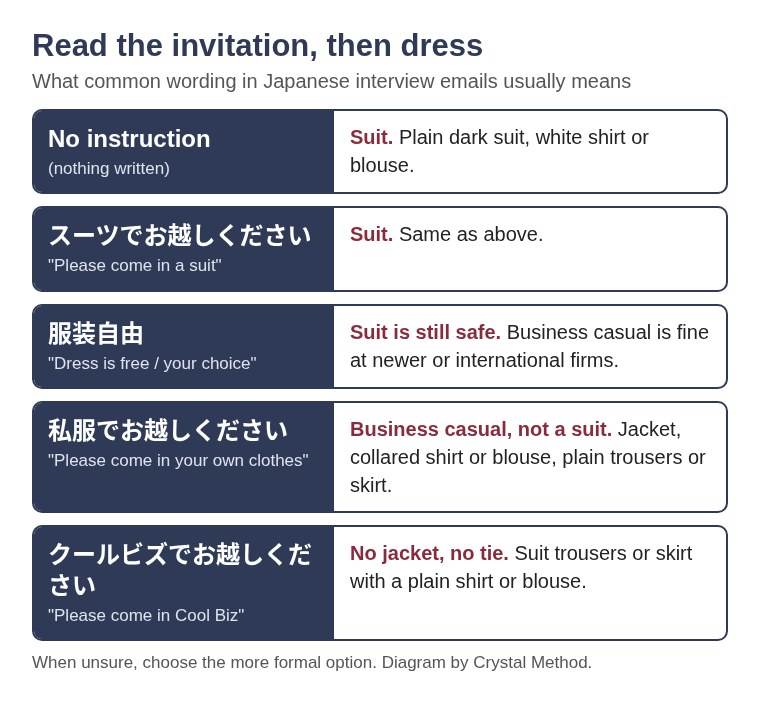
| Wording in the email | What it usually means | What to wear |
|---|---|---|
| Nothing written | The company assumes you know the norm. | Plain dark suit. |
| スーツでお越しください (sūtsu de okoshi kudasai) | “Please come in a suit.” | Plain dark suit. |
| 服装自由 (fukusō jiyū) | “Dress is up to you.” Often a sign the company is relaxed, but a suit is still accepted. | A suit is safe. Business casual is fine at newer or international firms. |
| 私服でお越しください (shifuku de okoshi kudasai) | “Please come in your own clothes.” The company wants to see you without a suit. | Business casual: jacket, collared shirt or blouse, plain trousers or skirt. Not jeans and a T-shirt. |
| クールビズでお越しください (kūru bizu de okoshi kudasai) | “Please come in Cool Biz,” the summer light-dress style. | No jacket and no tie; suit trousers or skirt with a plain shirt or blouse. |
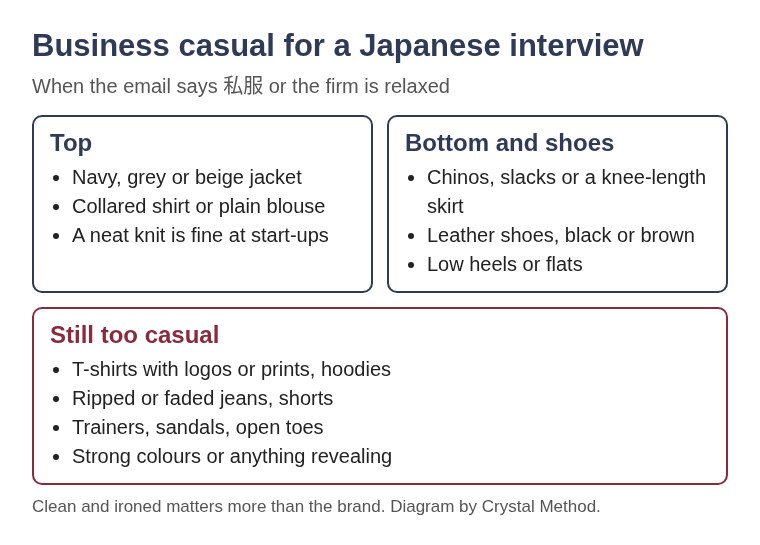
Own-clothes interviews are no longer unusual, even at Japanese groups. For example, FUJIFILM Software’s careers FAQ answers the dress question for both new graduates and experienced hires with “you may come in your own clothes rather than a suit,” adding that interviewers also attend in the clothes they normally work in. When a company says this clearly, take it at its word.
If you are not sure, it is acceptable to ask the recruiter by email, for example: 「当日の服装について、スーツでお伺いしてもよろしいでしょうか」 (“May I come in a suit on the day?”). When in doubt, choose the more formal option.
What to wear by type of company
New graduates at Japanese companies
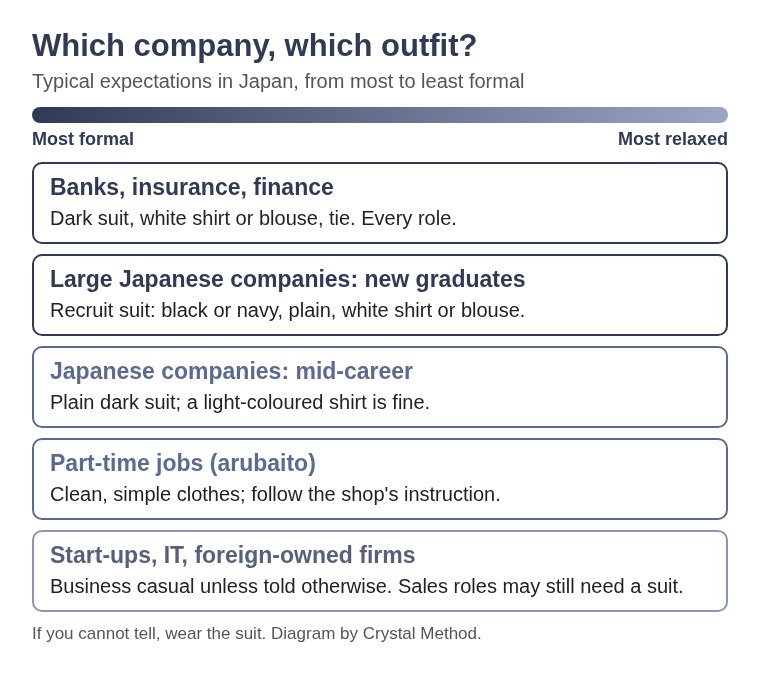
New graduates job hunting in Japan (shūkatsu) usually wear a recruit suit: black or navy, single-breasted, no pattern, worn with a plain white shirt or blouse. JASSO’s guide notes that suits designed for job hunting are sold. In Japan you can buy them at suit chains such as AOKI, Yōfuku no Aoyama, Konaka, THE SUIT COMPANY and ORIHICA, and at department stores, often as a set with a shirt, tie or blouse, and bag. Shops will shorten sleeves and trousers for you. The look is deliberately plain, so every candidate is judged on what they say.
Mid-career hires at Japanese companies
A plain dark suit is still the norm. You do not need a “recruit” look: a navy or charcoal suit you would wear to work is fine, and a light blue or other pale shirt is usually acceptable. A subtle stripe or check is fine. Match your belt to your shoes.
Banks, insurance and other finance companies
Expect the most formal standard: dark suit, white shirt or blouse, tie for men, polished shoes. This applies to every role, including IT and back-office roles, because the industry is seen as conservative.
Foreign-owned firms
Foreign-owned companies in Japan vary widely. Many US-based tech companies interview in business casual, while European banks, consultancies and luxury brands expect a suit. If a suit is expected, you have more freedom than at a Japanese firm: a navy or grey suit, a pale blue shirt, a tie with a quiet pattern and brown leather shoes are all normal. Look at what employees wear in the company’s own recruiting photos and videos, and follow the invitation or the recruiter’s advice.
Start-ups and IT companies
Business casual is common: a jacket or neat knit, a collared shirt or blouse, chinos or plain trousers, clean leather shoes. Many engineers interview without a suit. Customer-facing roles such as sales may still expect a suit, so check the invitation or ask. A suit is never wrong; it may just look a little stiff.
Fashion, beauty and design companies
In creative industries, how you dress can be part of what is assessed. If the company asks for own clothes, choose a clean outfit that shows your taste while staying appropriate for a business meeting. Apparel companies often like to see their own style of clothing, worn neatly.
Part-time jobs (arubaito)
For a part-time job interview at a shop, restaurant or convenience store, a suit is usually not necessary. Wear clean, simple clothes in calm colours: a shirt or blouse, plain trousers or skirt, clean shoes. Avoid ripped jeans, sandals and logo T-shirts. Students on a student visa should also check that the job fits their permission to work (資格外活動許可) before applying.
Men’s checklist
| Item | Safe choice | Avoid |
|---|---|---|
| Suit | Black, navy or charcoal; plain; single-breasted; well fitted | Bright colours, bold stripes, shiny fabric, a loose or tight fit |
| Shirt | White, plain, ironed; long sleeves | Dark or patterned shirts, rolled-up sleeves |
| Tie | Plain or small pattern in navy, dark red or grey; knot pushed up to the collar | Novelty prints, loud colours, a loose knot |
| Shoes and socks | Black leather lace-ups (plain or straight toe), polished; dark brown is fine for mid-career and foreign-owned firms; dark socks long enough that no skin shows when you sit | Trainers, worn heels, loafers at formal firms, white or ankle socks |
| Belt and watch | Plain belt matching the shoes; a simple watch | Large logos, smartwatch notifications during the interview |
Women’s checklist
| Item | Safe choice | Avoid |
|---|---|---|
| Suit | Black, navy or charcoal skirt suit or trouser suit, plain | Bright colours, short skirts, tight cuts |
| Blouse | White or very pale, plain, a modest neckline | Low necklines, see-through fabric, frills |
| Skirt | About knee length, so it still covers the knee when you sit | Above-knee or very tight skirts |
| Legs and shoes | Skin-tone stockings with a skirt; plain black pumps with a low heel (about 3 to 5 cm), closed toe | Bare legs, high heels, open toes, sandals |
| Make-up and jewellery | Natural make-up; small stud earrings or nothing; a simple watch | Strong colours, large earrings, many rings, bracelets |
Make-up and nails
- Base: a light foundation or tinted moisturiser close to your skin tone; aim for a fresh, healthy look rather than full coverage.
- Eyes: brown or neutral shades; thin eyeliner; mascara is fine. Avoid glitter, coloured liner and false lashes.
- Cheeks and lips: soft pink, coral or beige; avoid deep red, dark or glossy colours.
- Eyebrows: tidy and natural in shape.
- Nails: short and clean; bare, clear or pale pink polish. No nail art or long extensions.
- Online: cameras flatten colour, so slightly more definition on brows and lips can help, but keep it natural.
Going without make-up is acceptable; being neat matters more than wearing it.
At foreign-owned firms women have more freedom: a navy or grey suit, a pale-coloured blouse instead of white, a simple necklace and a slightly more fashionable cut are all normal. Follow the same rule as men: look at the company’s own recruiting materials, and when unsure, dress one step more formally.
A trouser suit is widely accepted. At a very conservative company, a skirt suit is the most traditional choice, but neither will be marked down as wrong.
How a suit should fit
A cheap suit that fits looks better than an expensive one that does not. Check these points in the mirror, wearing the shirt and shoes you will use:
- Shoulders: the shoulder seam sits at the edge of your shoulder, with no dent or overhang.
- Sleeves: the jacket sleeve ends at the wrist bone, so a little of the shirt cuff shows below it when your arms are down.
- Jacket length: long enough to cover your seat; the jacket closes without pulling into an X shape at the button.
- Collar: the jacket collar lies flat against the shirt collar, and a little of the shirt collar shows above it at the back.
- Trousers: the hem touches the top of your shoes, with little or no fold; no socks or skin show when you stand.
- Buttons: on a two-button jacket, fasten only the top button when standing; you can undo it when you sit.
Women’s jackets follow the same shoulder, sleeve and closing checks. Suit shops in Japan can adjust sleeves and hems, so ask when you buy.
Hair, grooming and accessories
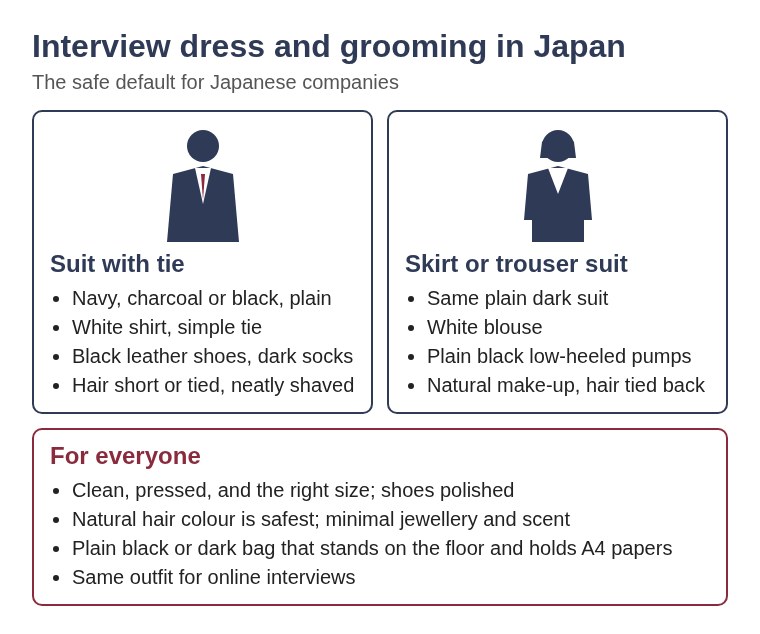
- Hair: clean and tidy, off the face. Long hair tied back. Your natural hair colour is the safest; bright dyed colours can count against you at traditional firms.
- Facial hair: clean-shaven is safest at Japanese companies. If you keep a beard, keep it short and neatly trimmed.
- Nails: short and clean; clear or very pale polish only.
- Scent: use deodorant, and avoid perfume or cologne that people can smell from across a desk.
- Tattoos and piercings: cover visible tattoos if you can; many Japanese workplaces are still conservative about them. Remove extra piercings or replace them with clear studs.
- Religious dress: if you wear a hijab, turban or other religious clothing, wear it. Choose a plain colour that goes with the suit.
- Glasses: fine. Choose simple frames rather than sunglasses or coloured lenses.
Bag, shoes and what to carry
Black or brown shoes? Black leather is correct everywhere and is the only safe choice for new graduates and finance. Brown leather shoes, with a matching belt, are acceptable for mid-career interviews at most companies and common at foreign-owned firms. Whatever the colour, keep them polished.
Bring a plain black or dark bag, large enough for A4 documents, that stands on its own on the floor. In the interview room you will put it at your feet, not on the chair or table. Make sure your shoes are polished and the heels are not worn down; interviewers see them when you bow and walk in.
What to put in the bag
| Item | Why |
|---|---|
| Resume and entry sheet copies, in a clear file | Interviewers ask questions while reading them; keep spares flat and clean. JASSO’s checklist lists a copy of your application form and your resume as things to bring just in case. |
| The invitation email or letter, and the company’s phone number | For reception, and to call before the start time if you are delayed. |
| Pen and notebook (or planner) | For notes and for any form you are asked to fill in. |
| Personal seal (印鑑, いんかん) and a red ink pad if it is not self-inking | JASSO’s checklist lists a personal seal as something to bring just in case; some companies ask you to stamp documents during the selection process or when you accept an offer. |
| Residence card (在留カード) | Foreign residents aged 16 and over must carry it at all times (Immigration Services Agency), and it is your photo ID if the company needs to check your status of residence. |
| Other photo ID if you have one (passport or Japanese driving licence) | Only if the company asks; follow the invitation. |
| Watch, handkerchief, small travel kit | A lint roller, comb, stain wipe and spare stockings help on long days. Turn your phone to silent before you enter the building. |
Summer, winter and rain
Summer. Japan’s summer is hot and humid. The Ministry of the Environment has promoted “Cool Biz,” a light-dress style for the warm season, since 2005, and from fiscal 2021 the government stopped setting one fixed national period, so each company decides. If the invitation says Cool Biz, you can skip the jacket and tie and wear suit trousers or skirt with a plain shirt or blouse. If it says nothing, wear the full suit to the interview, carry the jacket on the way, and put it on before you enter the building. Bring a handkerchief or small towel; it is normal in Japan.
Winter. Wear a plain coat (navy, black, grey or beige) over the suit. Take off your coat, scarf and gloves before you enter the building, fold the coat over your arm with the lining out, and put it on top of your bag. Thermal underwear is fine, but offices are well heated.
Rain. Carry a plain umbrella and a small towel to dry your shoes and bag. Leave the umbrella in the stand at the entrance or ask reception where to put it.
Online interviews
Dress for an online interview exactly as you would in person. JASSO’s guide includes “make sure there are no wrinkles in your suit” in its checklist for online interviews, together with a stable connection, a plain background, a bright room and a camera that shows your upper body. Wear the full outfit, including trousers or a skirt: you may need to stand up, or the camera may move. Avoid white shirts against a white wall if your camera washes out; a plain wall with soft light in front of you works best.
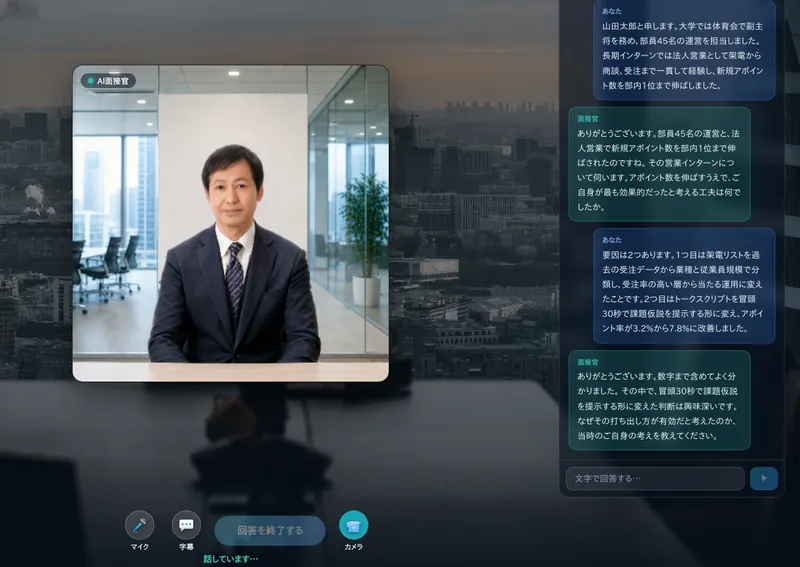
A useful habit is a full dress rehearsal: put on the interview outfit, sit where you will sit on the day, check how you look in your own camera app, and then practise answering out loud, for example with the AI interview practice tool shown below. The tool works in Japanese only.
Budget: what it costs
JASSO’s guide reports a questionnaire of international students on the cost of job hunting. In that questionnaire, the amount spent on “suits, bags, etc.” ranged from about 15,000 yen to 70,000 yen. Some students bought a suit set during a shop’s job hunting campaign; others used a suit they already owned. If you already have a plain dark suit that fits, you do not need a new one. Spend on fit and cleaning before brand.
Common mistakes
| Mistake | Why it hurts | Fix |
|---|---|---|
| Reading 服装自由 as “wear anything” | Jeans and a T-shirt can look as if you misread the setting. | Suit, or smart business casual at relaxed firms. |
| Coming in a suit when told 私服 | It can look as if you did not read the instruction. | Jacket, collared shirt or blouse, plain trousers or skirt. |
| A suit that does not fit | Sleeves too long or a tight jacket look careless. | Have it adjusted; most shops do it quickly. |
| Dirty or worn shoes | Interviewers notice shoes when you bow. | Polish the night before; check the heels. |
| Strong perfume | Many people in Japan find strong scent unpleasant in a small room. | Deodorant only. |
| Casual clothes on the bottom half online | Visible if you stand or the camera moves. | Wear the full outfit. |
Clothing is only one part of the impression. For what happens from reception to the thank-you email, see Japanese job interview etiquette; for what you will be asked, see Japanese job interview questions.
FAQ
Do I have to wear a suit to a job interview in Japan?
At most Japanese companies, yes, unless the invitation says otherwise. A plain dark suit with a white shirt or blouse is the safe default. Start-ups, many IT companies and foreign-owned firms often accept business casual, and some companies ask you to come in your own clothes.
What does 服装自由 mean in an interview email?
It means “dress is up to you.” A suit is still acceptable and the safest choice at Japanese companies; smart business casual is fine at relaxed or international firms. It does not mean jeans and a T-shirt.
What should I wear if the company says 私服 (own clothes)?
Business casual: a jacket or neat knit, a collared shirt or blouse, plain trousers or a knee-length skirt, and clean leather shoes. The company wants to see you without a suit, so do not wear one.
Can women wear a trouser suit to a Japanese interview?
Yes. Trouser suits are widely accepted. A skirt suit is the most traditional choice at very conservative companies, but a plain dark trouser suit will not be treated as a mistake.
Is a beard or dyed hair a problem?
At traditional Japanese companies, clean-shaven and natural hair colour are safest. A short, neatly trimmed beard is usually fine at international firms and start-ups. Bright hair colours can count against you at conservative companies.
What should I wear for an online interview?
The same as in person: the full suit or the outfit the company asked for, including trousers or a skirt. Check that your suit is not wrinkled, your background is plain and your face is well lit.
Sources
- Japan Student Services Organization (JASSO): Job Hunting Guide for International Students 2027 (English PDF). Clothing etiquette, the online interview checklist, the “things to bring just in case” checklist (personal seal, resume, copy of the application form), and the questionnaire on the cost of job hunting.
- Ministry of the Environment, Japan: COOL BIZ in FY2021 (Japanese press release). Cool Biz since 2005, the 28°C room temperature guide, and no fixed national period from 2021.
- FUJIFILM Software: careers FAQ (Japanese). Dress for interviews: own clothes rather than a suit, for new graduates and experienced hires.
- Immigration Services Agency of Japan: guide for foreign residents, Chapter 1 “Residence Card” (English PDF). Carrying the residence card at all times (age 16 and over).
For the whole hiring process and what interviewers assess, see the guide to Japanese job interviews. To rehearse in your interview clothes with a partner, see mock job interviews in Japan.
Practise a Japanese interview with an AI interviewer
The practice tool is in Japanese only and is free to try: AI interview practice tool (Japanese).
Supervised by
河合 継, CEO, Crystal Method
An AI researcher and the inventor on 16 patents related to AI and deep learning, with past joint research with the National Cancer Center Japan and AI commentary on Japanese TV programmes. Leads AI research and development at Crystal Method.
About the company (Japanese) | Editorial policy (Japanese)
This page is general information about job hunting in Japan. Last reviewed: 21 October 2026.
Study about AI
AIについて学ぶ
-

PHP脆弱性へのAIセキュリティ対策——中小企業・自治体担当者の実務ガイド
2026年10月21日、PHPに重大な脆弱性2件が確認され、国内の多数のサービスが予防的なサービス停止を余儀なくされた。システム担当者にとって他人事ではない。P...
-

面接のロールプレイング(ロープレ)とは?選考で出る課題の流れと、練習のやり方
面接のロールプレイング(面接ロープレ)とは?まず結論から 面接のロールプレイング(面接ロープレ)は、主に2つの意味で使われます(面接をする側の練習として行うこと...
-

MiniMax M3.1 Flashでできること——機能・使いどころ・注意点を解説
MiniMax M3.1 Flashは、テキスト・画像・動画を入力として受け付け、100万トークンのコンテキストウィンドウと常時オンの推論機能を備えた大規模言語...