
japanese-job-interview-questions
Japanese Job Interview Questions: 22 Questions With Example Answers in Japanese and English
The most common Japanese job interview questions are a self-introduction, your reason for applying, your strengths and weaknesses, what you worked hardest on, and your future goals. Foreign applicants also get a predictable second set: why Japan, how good your Japanese is, how long you plan to stay, your visa status, and whether you can accept overtime or a transfer. Below are 22 questions with the Japanese wording you will actually hear, what the interviewer wants to find out, and an answer pattern you can adapt.
- Learn to recognise the Japanese wording. Interviewers rarely ask in English at Japanese companies.
- Prepare a one-sentence conclusion for each question, then one specific episode. Keep spoken answers to about a minute.
- Check every answer against your entry sheet and resume. JASSO notes that interviewers often ask while reading your documents.
- All example answers on this page were written for this guide. They are not real candidates’ answers.
How to structure any answer
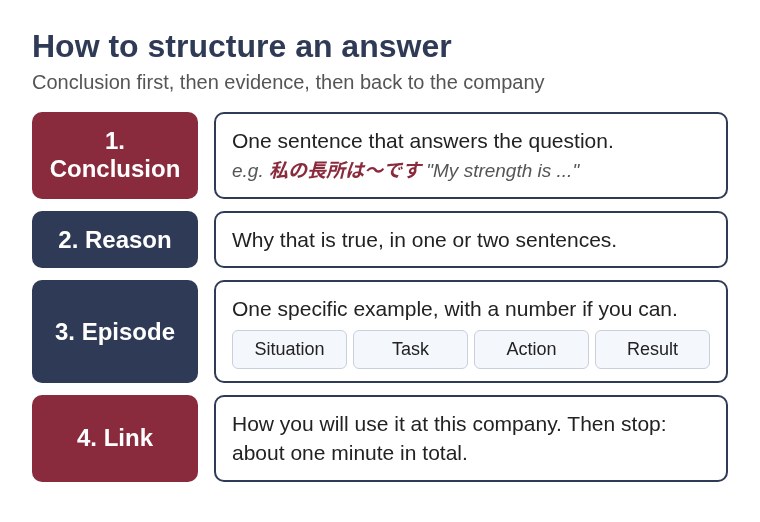
Japanese interviewers value answers that are easy to follow. A reliable pattern is conclusion first, then reason, then a specific episode, then the conclusion again (often called PREP). For questions about your experience, describe the episode as situation, task, your action and the result, the STAR method.
Specifics are what most answers lack. In Crystal Method’s AI interview practice tool (Japanese-language sessions, 26 June to 11 October 2026, scored automatically by AI), about 53% of improvement points concerned missing specifics such as concrete episodes or numbers, about 10% a missing reason, about 9% structure, and about 8% a conclusion that was unclear or came too late.
Why Japanese interviewers ask these questions
The question list makes more sense once you know how Japanese companies hire. Many hire new graduates in one batch, start them together in April and train them over several years, often rotating them between departments. JASSO’s guide notes that, especially for new graduates, companies emphasise character, cooperation and adaptability, and look at fit with their culture. That is why you hear so many questions about motivation, teamwork, future plans and how long you will stay, and fewer about narrow technical skills (except in specialist or mid-career roles). For a foreign applicant, an interviewer may also worry that you will return home after a short time; questions 13, 16 and 21 below are partly about that.
The standard questions (asked to everyone)
| Question in Japanese | What it means | What they are checking | Answer pattern |
|---|---|---|---|
| 1. 自己紹介をお願いします | Please introduce yourself | Can you summarise yourself in about a minute, politely? | Name and school or job, one thing you worked on, one line of greeting. |
| 2. 自己PRをしてください | Promote yourself / your main strength | One strength that is useful in this job, with evidence. | Strength, episode with a number, how you will use it here. |
| 3. 志望動機を教えてください | Why do you want to join us? | Why this company, not a competitor. | What you want to do, the experience behind it, what only this company offers. |
| 4. 学生時代に力を入れたことは何ですか | What did you put the most effort into as a student? | How you act when things are hard (often shortened to gakuchika). | STAR: the situation, your role, what you did, the result and what you learned. |
| 5. あなたの長所と短所を教えてください | Strengths and weaknesses | Self-awareness and honesty. | Strength with an episode; a real weakness plus what you do about it. |
| 6. 5年後、10年後はどうなっていたいですか | Where do you see yourself in 5 or 10 years? | Will you stay, and does your goal fit their career paths? | A goal reachable inside this company, and the first steps. |
| 7. 当社について知っていることを教えてください | What do you know about our company? | Did you research, and why does it matter to you? | Two facts (a product, a recent move) and why they attract you. |
| 8. 当社製品を使ったことはありますか | Have you used our products? | Genuine interest (listed by JASSO as typical). | Yes and what you noticed, or no and what you looked at instead. |
| 9. 困難を乗り越えた経験はありますか | Tell us about a difficulty you overcame | Problem solving and persistence. | STAR, with your own action in the centre. |
| 10. チームで取り組んだ経験を教えてください | Tell us about working in a team | Cooperation, your role in a group. | The team’s result, then your specific part in it. |
| 11. 他社の選考状況を教えてください | How are your other applications going? | Your priorities and timing (listed by JASSO). | Honest outline of industries and stages; no need to name every company. |
| 12. 最後に何か質問はありますか | Do you have any questions for us? | Interest and research. “No questions” reads as low interest. | One or two questions about the work itself (examples below). |
The same question, different wording
Interviewers often phrase the same question in another way. Recognise these so you do not freeze:
- Self-introduction: 簡単に自己紹介してください (“introduce yourself briefly”), これまでのご経歴を教えてください (“tell us about your career so far”, mid-career).
- Reason for applying: 応募理由を教えてください, なぜ当社を選んだのですか (“why did you choose us?”).
- Reason for leaving: 転職理由は何ですか (“why are you changing jobs?”), 退職の理由を教えてください.
- Effort as a student: 学生時代に頑張ったことは何ですか, ガクチカを教えてください.
- Japanese level: 日本語は仕事で使えますか (“can you use Japanese at work?”).
Questions foreign applicants are asked
| Question in Japanese | What it means | What they are checking | Answer pattern |
|---|---|---|---|
| 13. なぜ日本で働きたいのですか | Why do you want to work in Japan? | Is your reason serious and long-term? (JASSO lists this as typical.) | Past link to Japan, the work you want to do here, your future plan. |
| 14. なぜ日本に留学したのですか | Why did you study in Japan? | Consistency between study and career. | What you wanted to learn and how it connects to this job. |
| 15. 日本語はどのくらい話せますか | How much Japanese can you speak? | Can you work in Japanese? About 70% of companies want business-intermediate or higher at the offer stage (JASSO). | JLPT level if you have one, plus what you can actually do at work (meetings, email, phone). |
| 16. 日本にはどのくらい住む予定ですか | How long do you plan to stay in Japan? | Retention (listed by JASSO). | A sincere answer; link it to the career you want at this company. |
| 17. 在留資格は何ですか | What is your residence status (visa)? | Whether you can legally do this job and when. | Your current status and expiry date, and whether you need a change of status. |
| 18. 残業はできますか | Can you work overtime? | Flexibility and expectations. | Yes when needed, and ask how often it happens if you need to know. |
| 19. 転勤や配属について希望はありますか | Can you relocate? Any department preference? | Fit with Japanese job rotation. | Your preference, plus openness to other roles if true. |
| 20. 希望の部署に配属されなかったらどうしますか | What if you are not placed where you want? | Commitment to the company, not only the role (listed by JASSO). | You would learn from that role and still aim for your goal. |
| 21. いつから働けますか | When can you start? | Timing, notice period, visa timing. | A realistic date, including any status-change time. |
| 22. 前職を辞めた理由は何ですか | Why did you leave your last job? | Whether the same issue will happen here. | Forward-looking reason, no complaints about your employer. |
Example answers to the key questions
Each example gives the Japanese, then an English translation. Replace the details with your own; interviewers can tell a memorised template.
自己紹介 (self-introduction)
「〇〇大学大学院情報学研究科の〇〇と申します。研究では、画像から部品の傷を見つける仕組みを作っています。研究室では留学生の新入生に実験の手順を教える役も担当しました。本日はどうぞよろしくお願いいたします」
Romaji: “___ daigaku daigakuin jōhōgaku kenkyūka no ___ to mōshimasu. Kenkyū de wa, gazō kara buhin no kizu o mitsukeru shikumi o tsukutte imasu. Kenkyūshitsu de wa ryūgakusei no shinnyūsei ni jikken no tejun o oshieru yaku mo tantō shimashita. Honjitsu wa dōzo yoroshiku onegai itashimasu.”
“My name is ___, a graduate student in informatics at ___ University. In my research I am building a system that finds scratches on parts from images. In my lab I also teach experiment procedures to new international students. Thank you for your time today.”
How to build it, and how it differs from 自己PR: Japanese self-introduction for job interviews.
志望動機 (reason for applying)
「私が御社を志望するのは、製造現場の検査を自動化する仕事に携わりたいからです。研究で傷の検出に取り組み、現場の検査員の方に話を聞いた際、目視検査の負担の大きさを知りました。御社は検査装置で国内の工場に多くの導入先を持っているため、研究の経験を実際の現場で生かせると考えました」
“I want to join your company because I want to work on automating inspection in manufacturing. While researching defect detection, I spoke with inspectors and learned how heavy manual inspection is. Your company supplies inspection systems to many factories in Japan, so I could use my research in real workplaces.”
学生時代に力を入れたこと (what you worked hardest on)
「留学生会の会計として、イベント費用の管理方法を変えたことです。以前は領収書の紛失で毎回赤字の原因が分からなかったため、写真で記録する共有表を作りました。その結果、翌年は予算内でイベントを運営でき、次の担当者にも引き継げました」
“As treasurer of the international students’ association, I changed how we managed event costs. Lost receipts meant we never knew why we went over budget, so I set up a shared sheet where we recorded receipts by photo. The next year we ran our events within budget, and I handed the system over to my successor.”
Prepare a one-minute version and a longer two-to-three-minute version in case they ask you to say more.
長所と短所 (strengths and weaknesses)
「長所は、数字で課題を確かめて改善できることです。アルバイト先のカフェで廃棄が多かったため、曜日ごとの販売数を記録して仕込み量を見直し、廃棄を3割ほど減らしました。短所は、慎重すぎて決めるのに時間がかかることです。今は、期限を先に決めてから調べるようにしています」
“My strength is checking problems with numbers and fixing them. The café where I work part-time threw away a lot of food, so I recorded sales by day of the week and adjusted preparation, cutting waste by about 30%. My weakness is that I am overly careful and slow to decide. Now I set a deadline first and research within it.”
Avoid “weaknesses” that are really strengths (“I work too hard”); interviewers hear them constantly.
5年後どうなっていたいか (five-year goal)
「5年後には、検査装置の導入プロジェクトを任され、お客様の工場ごとに最適な設定を提案できる技術者になりたいです。そのために、最初の3年で装置の基本と現場の作業を一通り経験したいと考えています」
“In five years I want to lead installation projects for inspection systems and propose the right settings for each customer’s factory. To get there, I want to spend my first three years learning the equipment and the work on site.”
学歴・専攻 (your education and major)
Answer in this order: university and faculty, what you studied and why, one result (a project, thesis or certificate), and how it relates to the job. Keep it under a minute.
職務経験・実績 (work experience, for mid-career applicants)
「前職では、ECサイトの問い合わせ対応チームで3年間働きました。返品の問い合わせが多かったため、よくある質問のページを作り直し、問い合わせ件数を半年で約2割減らしました。御社でも、お客様の声を数字で整理して改善につなげたいと考えています」
“In my last job I worked for three years on an e-commerce customer support team. Returns generated many enquiries, so I rebuilt the FAQ page and cut enquiries by about 20% in six months. I want to bring the same habit of turning customer feedback into numbers and improvements here.”
Do not exaggerate. Japanese interviewers follow up with detailed questions (“What exactly did you do? How did you measure it?”), and an inflated number or a team result claimed as yours falls apart quickly. State your own part accurately and let the team share the credit; modesty with precise facts comes across better than boasting.
前職を辞めた理由 (why you left your last job)
Say the honest reason in a forward-looking way. Interviewers are checking whether the same problem would make you leave them too.
| What you might really feel | How to say it in the interview |
|---|---|
| The pay was too low. | 「成果がより評価に反映される環境で働きたいと考えました」 I want to work where results are reflected in evaluation. |
| I was bored; the work never changed. | 「〇〇の経験を生かして、より幅広い業務に挑戦したいと考えました」 I want to use my experience in X to take on a wider range of work. |
| My boss and I did not get on. | 「チームで意見を出し合いながら進める環境で力を発揮したいと考えました」 I do my best work in a team where people share ideas. |
| Too much overtime. | 「業務の進め方を見直しながら、長く働き続けられる環境を選びたいと考えました」 I want an environment where I can keep improving how work is done and stay for the long term. |
Do not criticise your former employer, and make sure the new company actually offers what you say you want.
希望年収 (expected salary)
New graduate: 「御社の規定に従います」 (“I will follow your company’s pay scale.”) New-graduate pay is usually set by the company.
Mid-career: 「現在の年収が〇〇万円ですので、〇〇万円から〇〇万円の範囲を希望しております。ただ、仕事の内容を重視しておりますので、ご相談させてください」 (“My current salary is ¥X, so I am hoping for a range of ¥Y to ¥Z, but the work matters most to me, so I am happy to discuss it.”)
日本語はどのくらい話せますか (Japanese level)
「日本語能力試験のN2を持っています。研究室のミーティングやアルバイト先での電話対応は日本語で行っています。敬語のメールはまだ時間がかかるので、毎週、先輩に確認してもらいながら練習しています」
“I have JLPT N2. I use Japanese in lab meetings and on the phone at my part-time job. Polite business email still takes me time, so I practise every week and have a senior student check it.”
Many job postings state a required level, often JLPT N2 or N1 for Japanese-speaking roles. If your level is below what the posting asks, be honest and say what you are doing to improve.
なぜ日本で働きたいのですか (why Japan)
Weak: 「日本の文化が好きだからです」 (“Because I like Japanese culture.”)
Stronger: 「日本の製造業の品質管理を、現場で学びたいからです。将来は、その経験を生かして母国の工場と日本企業の取引を支えたいと考えています」 (Nihon no seizōgyō no hinshitsu kanri o, genba de manabitai kara desu. Shōrai wa, sono keiken o ikashite bokoku no kōjō to Nihon kigyō no torihiki o sasaetai to kangaete imasu.) (“I want to learn quality control in Japanese manufacturing on the shop floor, and later use that to support business between factories in my home country and Japanese companies.”)
Researching the company for questions 3, 7 and 8
Before each round, check the company’s mission or philosophy (企業理念), main products and customers, news and press releases from the past year, the medium-term plan for listed companies, and the recruitment page. Use one fact in your reason for applying and turn another into an end-of-interview question.
Phrases and manners in the room
These set phrases come up in every interview. Romaji is given to help pronunciation.
| Japanese | Romaji | When to use it |
|---|---|---|
| 失礼します | shitsurei shimasu | When you enter the room after knocking, and when you leave. |
| はじめまして、〇〇と申します | hajimemashite, ___ to mōshimasu | Your first greeting beside the chair, before you sit. |
| 本日はよろしくお願いいたします | honjitsu wa yoroshiku onegai itashimasu | After giving your name and at the end of the self-introduction. |
| 恐れ入りますが、もう一度お願いできますか | osore irimasu ga, mō ichido onegai dekimasu ka | When you did not catch a question. |
| 御社 | onsha | “Your company” when speaking (貴社 kisha is for writing). |
| 本日はありがとうございました | honjitsu wa arigatō gozaimashita | When the interview ends, before you bow and leave. |
Arrive about 15 minutes early (JASSO’s advice), give your name and the purpose of your visit at reception, and wait quietly; the interview effectively starts there. Knock two or three times, enter when told, bow, give your name, and sit only when invited. For dress, a plain dark suit is the safe default at traditional Japanese companies; some IT companies and start-ups say “business casual” or “come as you are”, and you can follow that if they say so in writing. When unsure, wear the suit. The guide to Japanese job interviews covers the day-of flow, bows and dress in more detail.
Questions to ask at the end (逆質問)
Prepare two or three, and choose ones the website does not already answer.
- 「入社までに勉強しておくとよいことはありますか」 Is there anything I should study before joining?
- 「配属後の最初の1年は、どのような仕事を担当することが多いですか」 What work do new members usually do in their first year?
- 「外国籍の社員の方は、どのような部署で活躍されていますか」 In which departments do employees from overseas work?
Avoid making salary, holidays or overtime your first question in an early round. Ask about conditions later in the process or through the recruiter.
Questions you do not have to answer in detail
Japan’s labour ministry asks employers not to collect information unrelated to aptitude and ability, such as your birthplace, your family’s jobs or income, your religion, political views, “the person you respect most” or the books you read. If you are asked, you can answer briefly and bring the conversation back to the job. The guide to Japanese job interviews lists these matters and explains the whole hiring process.
Practise answering out loud
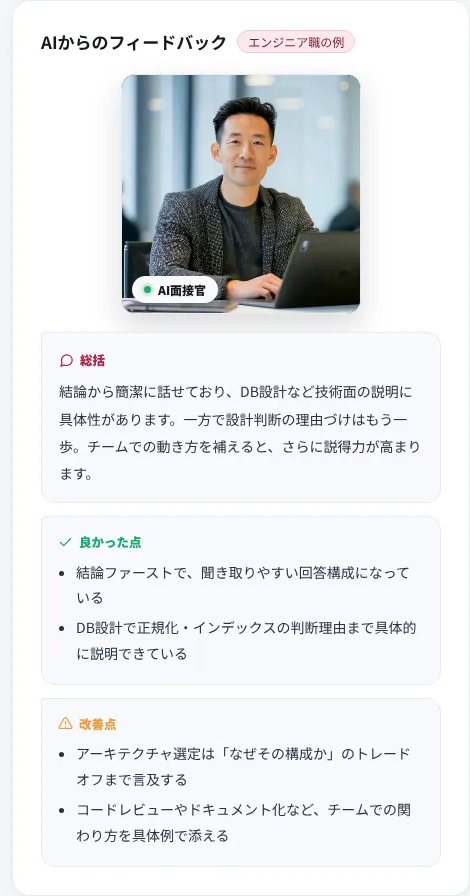
Reading answers is not the same as saying them under pressure. For places to book a mock interview in Japan and a question sheet for your practice partner, see mock job interviews in Japan. JASSO suggests recording yourself and reviewing eye contact, clarity and language, and doing mock interviews with a friend or career counsellor. Crystal Method’s AI interview practice tool asks follow-up questions to your answers and then gives written feedback. It is in Japanese only, so it is useful once you are preparing for an interview in Japanese.
FAQ
What is the most common question in a Japanese job interview?
The self-introduction (自己紹介をお願いします) opens almost every interview, and the reason for applying (志望動機) is asked in nearly every round. For foreign applicants, “Why do you want to work in Japan?” is close behind.
How do I impress a Japanese interviewer?
Answer the question directly with the conclusion first, support it with one specific episode, keep it to about a minute, and make sure it matches your entry sheet. Polite, simple Japanese and good manners matter more than complex vocabulary.
Should I answer in Japanese or English?
Answer in the language of the interview. At most Japanese companies that is Japanese. If you do not understand a question, ask politely: 「恐れ入りますが、もう一度お願いできますか」 (“Sorry, could you say that again?”)
How long should my answers be?
About one minute for most answers, including the self-introduction, unless the interviewer gives a different time. In group interviews, shorter is better because each person has less time.
What is gakuchika?
Short for 学生時代に力を入れたこと, “what you put the most effort into as a student”. It is a standard new-graduate question; answer it with the STAR method and your own actions.
Is it rude to ask about salary in a Japanese interview?
It is not forbidden, but leading with salary or holidays in an early round can look like your main interest. Raise conditions later in the process or through the recruiter.
Sources
- Japan Student Services Organization (JASSO): Job Hunting Guide for International Students 2027 (English PDF). Typical questions for international students, Japanese level sought by companies, interview advice and practice.
- Tokyo Labour Bureau (MHLW): Fair recruitment and the 14 matters to consider in selection (Japanese)
- Crystal Method AI interview practice tool: usage data from 26 June to 11 October 2026 (Japanese-language sessions, automatic AI scoring). Percentages only; the data is not limited to foreign users.
Practise these questions with an AI interviewer
The practice tool is in Japanese only and is free to try: AI interview practice tool (Japanese).
Supervised by
河合 継, CEO, Crystal Method
An AI researcher and the inventor on 16 patents related to AI and deep learning, with past joint research with the National Cancer Center Japan and AI commentary on Japanese TV programmes. Leads AI research and development at Crystal Method.
About the company (Japanese) | Editorial policy (Japanese)
This page is general information about job hunting in Japan. Last reviewed: 21 October 2026.
Study about AI
AIについて学ぶ
-

PHP脆弱性へのAIセキュリティ対策——中小企業・自治体担当者の実務ガイド
2026年10月21日、PHPに重大な脆弱性2件が確認され、国内の多数のサービスが予防的なサービス停止を余儀なくされた。システム担当者にとって他人事ではない。P...
-

面接のロールプレイング(ロープレ)とは?選考で出る課題の流れと、練習のやり方
面接のロールプレイング(面接ロープレ)とは?まず結論から 面接のロールプレイング(面接ロープレ)は、主に2つの意味で使われます(面接をする側の練習として行うこと...
-

MiniMax M3.1 Flashでできること——機能・使いどころ・注意点を解説
MiniMax M3.1 Flashは、テキスト・画像・動画を入力として受け付け、100万トークンのコンテキストウィンドウと常時オンの推論機能を備えた大規模言語...