
japanese-self-introduction-jiko-pr-interview
Japanese Self-Introduction for a Job Interview: Jiko Shokai and Jiko PR With Example Scripts
In a Japanese job interview, the first request is almost always 「自己紹介をお願いします」 (じこしょうかいをおねがいします, “please introduce yourself”). A good answer takes about one minute: your school or company and name, what you study or do now, one thing you worked hard on, a short link to the company, and a polite closing. It is not the same as 自己PR (じこピーアール, self-promotion), where you argue one strength with evidence. This page explains the difference, gives a template and example scripts in Japanese with readings and English, and shows how to practise until it sounds natural.
- Length: about one minute, roughly 250 to 300 Japanese characters. Have a 30-second version ready too.
- Five parts: name and school or company, what you do now, one episode, link to the company, closing.
- 自己紹介 ≠ 自己PR: introduce yourself in outline first; save the argument for your strengths for 自己PR.
- Use polite forms: 〇〇と申します (と もうします) for your name, 御社 (おんしゃ) for “your company,” and close with よろしくお願いいたします.
- Do not recite: learn the points, not every word, so you can adjust if the interviewer says “briefly” or “in two minutes.”
What interviewers want from your self-introduction
The self-introduction is the opening of the conversation, not a test of how much you can say. Interviewers use it to hear how you speak Japanese, check that you can summarise yourself clearly, and pick a topic for their next question. That is why a short episode is useful: it gives them something to ask about. A one-minute answer that ends cleanly shows that you can follow the format of a Japanese business conversation, which matters as much as the content.
JASSO’s job hunting guide for international students advises preparing a spoken description of your strengths of about one minute, and short, to-the-point answers to common questions. Most interviewers expect the self-introduction to be about the same length.
自己紹介 vs 自己PR: two different answers
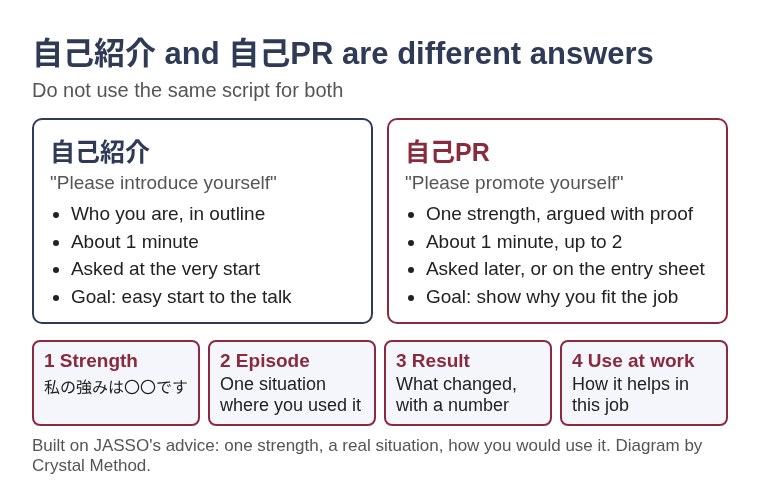
| 自己紹介 (self-introduction) | 自己PR (self-promotion) | |
|---|---|---|
| How it is asked | 自己紹介をお願いします | 自己PRをお願いします / あなたの強みを教えてください |
| When | At the start of almost every interview | Later in the interview, and on the entry sheet |
| Content | Who you are, in outline, with one short episode | One strength, a real situation that proves it, and how it helps in the job |
| Length | About 1 minute | About 1 minute, up to 2 if asked |
A common mistake is to give the full self-PR when asked for a self-introduction. It runs long and leaves nothing new for the later question. Mention your episode in one or two sentences in the self-introduction, and develop it in 自己PR.
The one-minute template
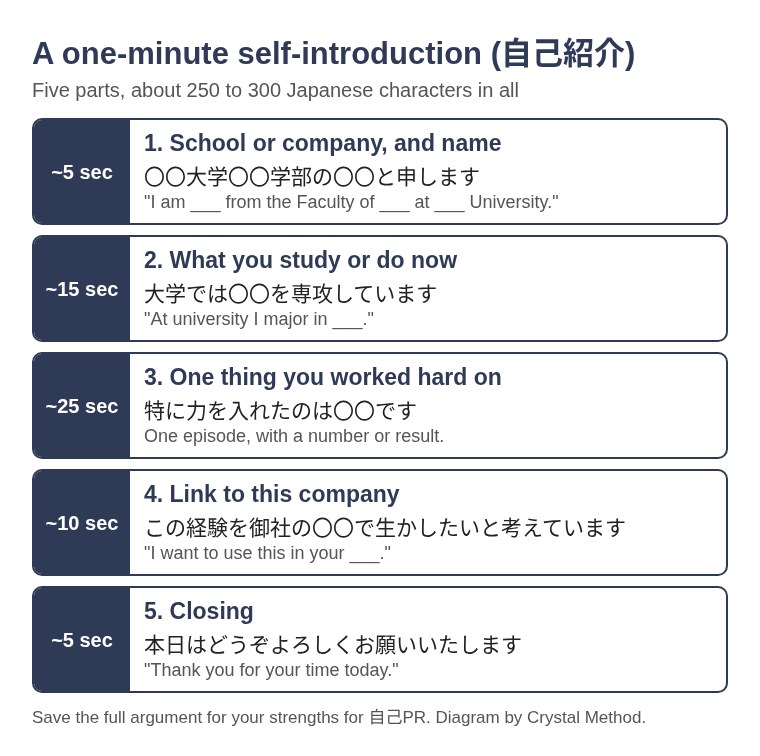
Spoken Japanese at an interview pace is roughly 300 characters a minute, so a one-minute self-introduction is about 250 to 300 characters. Time yourself: most people who are nervous either speak too fast or add too much.
Phrases you will use, with readings
| Japanese | Reading | Meaning and use |
|---|---|---|
| 〇〇と申します | 〇〇と もうします | “My name is ___.” Humble form; use instead of です for your name. |
| 〇〇大学〇〇学部〇年の | 〇〇だいがく 〇〇がくぶ 〇ねんの | “___ University, Faculty of ___, year ___.” Say your school before your name. |
| 〇〇を専攻しています | 〇〇を せんこうしています | “I major in ___.” |
| 現在、〇〇として働いております | げんざい、〇〇として はたらいております | “I currently work as ___.” For mid-career applicants. |
| 特に力を入れたのは〇〇です | とくに ちからをいれたのは 〇〇です | “What I worked hardest on is ___.” |
| 御社 | おんしゃ | “Your company,” when speaking. In writing use 貴社 (きしゃ). |
| 生かしたいと考えております | いかしたいと かんがえております | “I would like to make use of it.” |
| 本日はどうぞよろしくお願いいたします | ほんじつは どうぞ よろしく おねがいいたします | “Thank you for your time today.” The standard closing. |
Readings on this page are given in hiragana rather than romaji. Interview Japanese is spoken, and reading kana trains the pronunciation and the polite endings at the same time; if you cannot yet read kana, learn it before the interview, because at Japanese companies entry sheets and emails are usually in Japanese too.
Saying where you are from
| Japanese | Reading | Meaning and use |
|---|---|---|
| 〇〇出身です | 〇〇しゅっしんです | “I am from ___.” Works for a country or a city: ベトナム出身, ムンバイ出身. |
| 〇〇から参りました | 〇〇から まいりました | “I came from ___.” More humble; fine in interviews. |
| 国籍は〇〇です | こくせきは 〇〇です | “My nationality is ___.” Use if your nationality and where you grew up differ. |
| 日本に来て〇年になります | にほんに きて 〇ねんに なります | “I have been in Japan for ___ years.” Useful context for your Japanese level. |
〇〇人です (〇〇じんです, “I am ___ [nationality]”) is correct but sounds plain in an interview; 〇〇出身です is the more common choice.
Hobbies: only if they help
In a job interview, hobbies are not part of the standard self-introduction. Add one only if it supports the impression you want, or if the interviewer asks: 「趣味は〇〇です」 (しゅみは 〇〇です, “My hobby is ___”), followed by one sentence on what it shows, for example 「週末は10キロ走っており、続ける力には自信があります」 (“I run 10 km every weekend, so I am confident in my persistence”). For a part-time job interview, a hobby related to the shop is a good addition.
What よろしくお願いいたします really means
よろしくお願いします (よろしく おねがいします) has no exact English equivalent. Literally it asks the other person to treat you favourably; in practice it means “thank you in advance” or “I look forward to working with you,” and it closes almost every introduction and business email in Japan. In an interview use the more humble form よろしくお願いいたします, and add 本日は (today) or どうぞ for extra politeness. If someone says it to you, the reply is こちらこそ、よろしくお願いいたします (“likewise”). Say it, then give a small bow of about 15 degrees while seated.
Foreign names are usually said in katakana in the order you write them on your resume. If your name is long, say it once clearly and add how you like to be called, for example 「〇〇とお呼びください」 (〇〇と およびください, “please call me ___”).
Example scripts
These examples were written by Crystal Method for practice. Replace every detail with your own; interviewers can tell when an answer is borrowed.
New graduate (international student), about one minute
〇〇大学経済学部4年の〇〇と申します。ベトナムのホーチミン出身で、日本に来て4年になります。大学ではマーケティングを専攻し、地方の観光と若者の行動についてゼミで研究しています。特に力を入れたのは、留学生向けの日本語交流会の運営です。参加者が減っていたため、毎回アンケートを取り、テーマを参加者が選べる形に変えたところ、半年で参加者が約2倍になりました。この経験から、相手の声を聞いて改善することの大切さを学んでいます。御社の海外向けマーケティングで、この姿勢を生かしたいと考えております。本日はどうぞよろしくお願いいたします
“I am ___, a fourth-year student in the Faculty of Economics at ___ University. I am from Ho Chi Minh City in Vietnam and have lived in Japan for four years. I major in marketing and research regional tourism and young people’s behaviour in my seminar. What I worked hardest on was running a Japanese language exchange for international students. Attendance was falling, so I surveyed participants every time and let them choose the topics; in six months attendance roughly doubled. I learned how important it is to listen and improve. I would like to bring that attitude to your overseas marketing. Thank you for your time today.”
Mid-career (engineer), about one minute
〇〇と申します。インド出身で、現在は東京のIT企業で、ECサイトのバックエンド開発を担当しております。前職と合わせて6年間、決済と在庫管理のシステムに携わってきています。特に力を入れたのは、注文が集中する時期の障害を減らす取り組みです。チームで原因を分析し、処理の仕組みを見直した結果、繁忙期の障害件数を前年の半分以下に抑えることができています。御社では、この経験を物流システムの安定運用に生かしたいと考えております。本日はよろしくお願いいたします
“My name is ___. I am from India and currently work at an IT company in Tokyo, developing the back end of an e-commerce site. Including my previous job, I have worked on payment and inventory systems for six years. What I focused on most was reducing outages during peak ordering periods. My team analysed the causes and redesigned the processing, which kept peak-season outages to less than half of the previous year. I would like to use this experience to help your logistics systems run reliably. Thank you for your time today.”
Short version (about 30 seconds)
〇〇大学工学部4年の〇〇と申します。大学では画像認識を研究しており、学園祭の混雑を予測する仕組みを仲間と作った経験があります。御社の製品開発でこの経験を生かしたいと考えております。本日はよろしくお願いいたします
“I am ___, a fourth-year engineering student at ___ University. I research image recognition, and with friends I built a system to predict crowding at our school festival. I would like to use this experience in your product development. Thank you for your time today.”
Part-time job (arubaito)
〇〇と申します。〇〇日本語学校に通っており、週に3日、夕方から働くことができます。国では2年間カフェで働いていたので、接客には慣れています。どうぞよろしくお願いいたします
“My name is ___. I attend ___ Japanese Language School and can work three evenings a week. I worked in a café for two years in my home country, so I am used to serving customers. Thank you.”
Linking your episode to the company
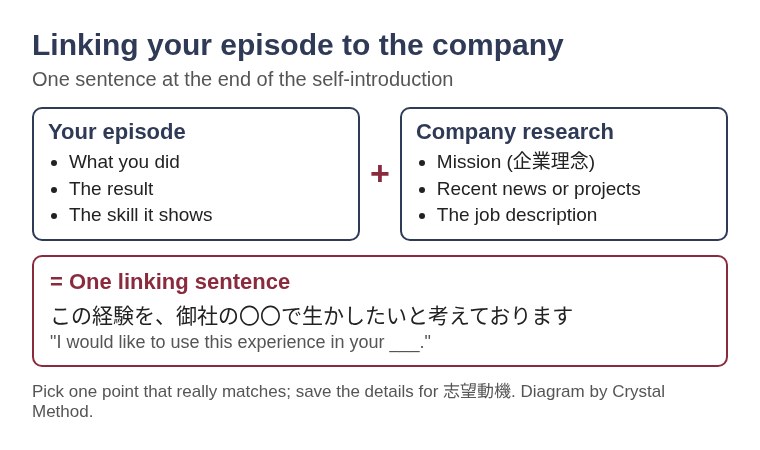
The last content sentence of each script connects you to the company. Before writing it, read the company’s mission (企業理念), its recent news or projects, and the job description, and choose one point that genuinely matches your episode: a market it is entering, a product you have used, a skill the job description names. Keep it to one sentence here; the full reasoning belongs to 志望動機 (しぼうどうき, reason for applying), which comes later.
Students on a student visa should confirm that the hours fit their permission to work outside their status (資格外活動許可). JASSO’s Student Guide to Japan states the limit as 28 hours a week, or up to eight hours a day during long school holidays.
How to write your 自己PR
JASSO’s guide gives clear advice for self-PR: rather than listing all your strengths, focus on one and describe it in detail; describe situations where you showed it; and explain how you would use that strength in the job you are applying for. A simple order is strength → episode → result → use at work.
私の強みは、相手の立場に立って考えられることです。大学の国際交流サークルでは、新入生の留学生が授業の登録で困っていることに気づき、先輩と協力して多言語の手順書を作りました。翌年から、登録に関する相談は大きく減っています。御社の営業職でも、お客様の立場で課題を考え、提案に生かしたいと考えております
“My strength is that I can see things from the other person’s point of view. In my university’s international exchange club, I noticed that new international students had trouble registering for classes, so I worked with senior members to create multilingual instructions. From the next year, questions about registration fell sharply. In your sales role, I want to think about problems from the customer’s side and use that in my proposals.”
The weak point in most self-PRs is the episode. In Crystal Method’s AI interview practice tool (Japanese), about 53% of the improvement points in the AI’s feedback asked for more specific answers: what exactly you did, with numbers or concrete actions. About 10% concerned the reason behind an answer and about 9% the structure. When you check your script, ask: could someone else say exactly the same sentence? If yes, add a detail only you could give.
Delivery: how to say it
- Wait for the cue. After you sit, the interviewer will ask for the self-introduction. Do not start before.
- Start with a short thanks if you like: 「本日はお時間をいただき、ありがとうございます」 (ほんじつは おじかんを いただき、ありがとうございます). It is polite, but keep it to one sentence.
- Speak a little slower than normal, with a short pause between parts. Clear Japanese at a steady pace sounds more confident than fast Japanese.
- Look at the interviewer, or at the camera online, not at the ceiling or your notes.
- Adjust the length when told 「簡単に」 (“briefly”: use the 30-second version) or 「2分程度で」 (“in about two minutes”: add a second episode).
- Finish clearly with よろしくお願いいたします, then a small nod. A trailing “…that’s all” weakens the end.
For bowing, sitting and the other manners around the self-introduction, see Japanese job interview etiquette.
Practise until it sounds natural
Write the script, read it aloud with a timer, then cut it to keywords and practise from the keywords only. Record yourself once on video and check the speed and eye contact. Then practise in front of someone who will ask a follow-up question, because the real interview continues from what you say.
In the same tool’s data, completed sessions of ten minutes or longer had a median overall score of 54.6, against 13 for sessions of one to three minutes, so a full-length rehearsal is worth more than a quick run-through. These figures cover all users practising in Japanese from June to October 2026, not only foreign applicants. The feedback screen shows what went well and what to improve:
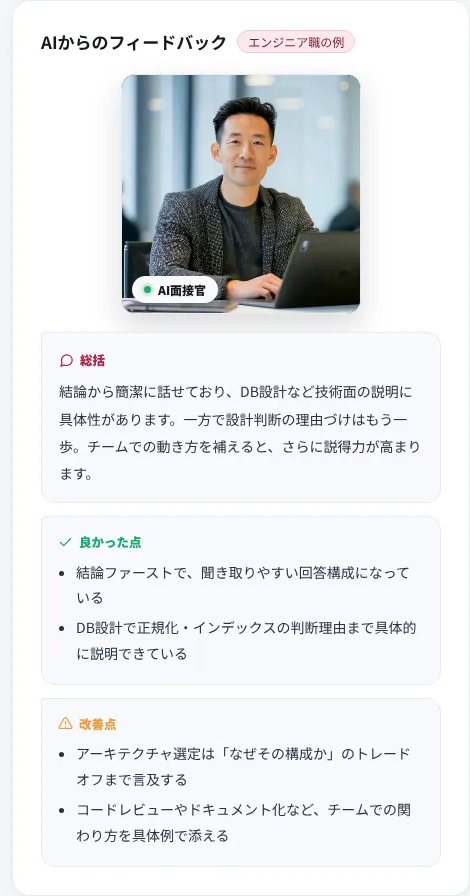
For other ways to rehearse, including free mock interviews at public employment centres and universities, see mock job interviews in Japan.
Common mistakes
| Mistake | Why it hurts | Fix |
|---|---|---|
| Talking for three minutes | Looks as if you cannot summarise | Time it; one minute unless asked |
| Giving the full 自己PR | Nothing new left for later questions | One or two sentences on the episode only |
| Reciting word for word | Sounds unnatural; breaks down if interrupted | Practise from keywords |
| です instead of と申します for your name | Slightly casual for an interview | 〇〇と申します |
| Starting with your life story or hobbies | Not what the interviewer needs first | School or company first, hobbies only if relevant |
| Contradicting your resume | Interviewers read along with your documents | Check dates, majors and job titles before the day |
| No closing | The end is unclear | 本日はよろしくお願いいたします |
After the self-introduction, the interview usually moves to your reasons for applying and your experience. For those questions and example answers, see Japanese job interview questions.
FAQ
How do you introduce yourself in a Japanese job interview?
Give your school or company and name with 〇〇と申します, say what you study or do now, mention one thing you worked hard on with a result, link it to the company in one sentence, and close with 本日はよろしくお願いいたします. Keep it to about one minute.
How long should a self-introduction be in a Japanese interview?
About one minute, roughly 250 to 300 Japanese characters. Prepare a 30-second version for when the interviewer says 簡単に (“briefly”), and be ready to extend to two minutes if asked.
What is the difference between 自己紹介 and 自己PR?
自己紹介 is a short outline of who you are, asked at the start. 自己PR argues one strength with a specific episode and explains how it helps in the job. Do not give the full self-PR when asked for a self-introduction.
Should I say はじめまして at the start?
It is not wrong, but it is not needed. Most applicants start with their school or company and name, or with a short thanks for the interviewer’s time.
Can I use English in my self-introduction?
If the interview is in Japanese, give the self-introduction in Japanese. If you are applying to an English-speaking role, the company may ask for it in English; follow the interviewer’s lead.
Should I memorise my self-introduction?
Memorise the structure and key points, not every word. Practise from keywords so you can shorten or extend the answer naturally.
Sources
- Japan Student Services Organization (JASSO): Job Hunting Guide for International Students 2027 (English PDF). Preparing a one-minute spoken description of your strengths, short answers to common questions, and how to write self-PR (one strength, situations, use in the job).
- Japan Student Services Organization (JASSO): Student Guide to Japan 2026-2027 (English PDF). Part-time work with permission: within 28 hours a week.
- Crystal Method AI interview practice tool: usage data from 26 June to 11 October 2026 (Japanese-language sessions, automatic AI scoring). Percentages only; the data is not limited to foreign users.
For the whole hiring process and what interviewers assess, see the guide to Japanese job interviews.
Practise your self-introduction with an AI interviewer
The practice tool is in Japanese only and is free to try: AI interview practice tool (Japanese).
Supervised by
河合 継, CEO, Crystal Method
An AI researcher and the inventor on 16 patents related to AI and deep learning, with past joint research with the National Cancer Center Japan and AI commentary on Japanese TV programmes. Leads AI research and development at Crystal Method.
About the company (Japanese) | Editorial policy (Japanese)
This page is general information about job hunting in Japan. Last reviewed: 21 October 2026.
Study about AI
AIについて学ぶ
-

PHP脆弱性へのAIセキュリティ対策——中小企業・自治体担当者の実務ガイド
2026年10月21日、PHPに重大な脆弱性2件が確認され、国内の多数のサービスが予防的なサービス停止を余儀なくされた。システム担当者にとって他人事ではない。P...
-

面接のロールプレイング(ロープレ)とは?選考で出る課題の流れと、練習のやり方
面接のロールプレイング(面接ロープレ)とは?まず結論から 面接のロールプレイング(面接ロープレ)は、主に2つの意味で使われます(面接をする側の練習として行うこと...
-

MiniMax M3.1 Flashでできること——機能・使いどころ・注意点を解説
MiniMax M3.1 Flashは、テキスト・画像・動画を入力として受け付け、100万トークンのコンテキストウィンドウと常時オンの推論機能を備えた大規模言語...