
japanese-job-interview-etiquette
Japanese Job Interview Etiquette: Step-by-Step Manners From Arrival to Thank-You Email
Japanese job interview etiquette comes down to a fixed sequence: arrive early, treat reception as part of the interview, knock before entering, bow, wait to be invited to sit, answer politely and briefly, and thank the interviewers as you leave. None of it is complicated, but interviewers notice when a step is missed, because in Japan these manners are read as a sign of how you will behave with colleagues and customers. This page explains each step, the reason behind it, and what to say in Japanese.
- Arrive at the venue about 15 minutes early; for online interviews, log in 5 minutes early (JASSO).
- If you will be late, phone before the start time, not after.
- Knock two or three times, say 失礼します (shitsurei shimasu), bow, and sit only when invited.
- Use polite Japanese: 私 (watashi) not 僕, 御社 (onsha) for “your company” when speaking, 承知しました not 了解しました.
- Bow again at the door when you leave, and send a short thank-you email the same day if you can.
Why etiquette matters so much in Japanese interviews
JASSO’s job hunting guide for international students says that, especially for new graduates, Japanese companies emphasise character, cooperation and adaptability. Manners are one of the few things an interviewer can observe directly: how you treat the receptionist, whether you wait to be seated, how you listen. A strong answer delivered with poor manners can still leave a weak impression. The good news is that the rules are predictable, so you can learn them in an afternoon.
If you are used to interviews in the US or Europe, expect three differences. First, formality: the sequence of knocking, bowing and waiting to sit is followed closely, and small talk is rare. Second, modesty and the group: confident self-promotion is fine, but answers that put the team’s result first and then explain your part usually land better than “I did it all”. Third, listening: interviewers often speak slowly and leave pauses; let them finish, and do not interrupt.
Before the day
- Confirm the details by email: date, time, place, the name of the person you will meet, and what to bring. Reply promptly and politely to any email from the company.
- Prepare what to bring: extra copies of your resume and entry sheet, a pen and notebook, a clear file to keep documents flat, the company’s contact number, and anything the company asked for.
- Check the route and allow for delays. Note the station and walking time.
- Re-read your documents. Interviewers often ask while reading your entry sheet and resume, and your answers must match them.
- Clothes: a plain dark suit is the safe default at Japanese companies; follow the company’s instructions if it says otherwise.
- Foreign residents: carry your residence card (在留カード, zairyū kādo); the Immigration Services Agency says holders aged 16 and over must carry it at all times, and the company may ask about your status of residence.
- Online: test your connection, microphone and camera the day before, on the device and app you will use.
Dress and grooming
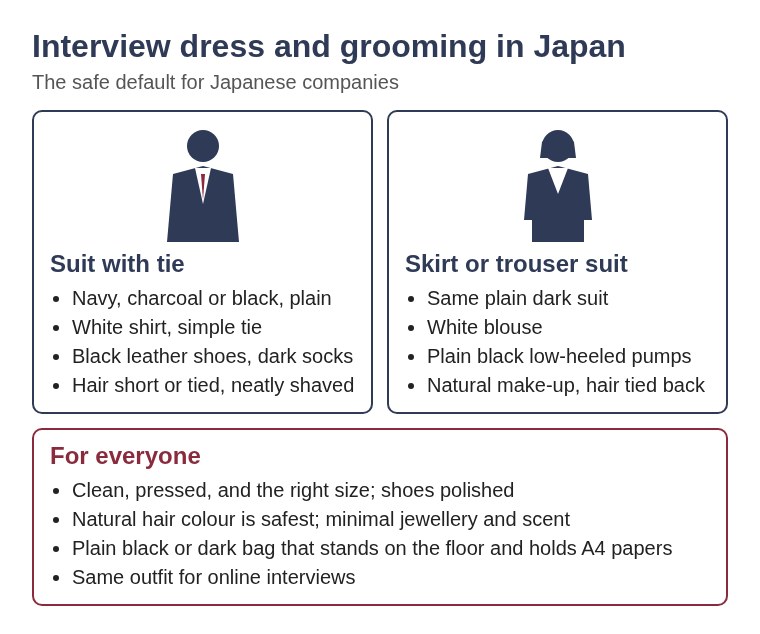
JASSO’s guide says what you wear shows the company that you take the interview seriously and have social common sense, and notes that suits made for job hunting (“recruit suits”) are widely sold. Grooming matters as much as the suit: shave or keep a beard very neat, keep hair tidy and away from your face, keep nails short and clean, and avoid strong perfume. Cover visible tattoos if you can, since many Japanese workplaces are still conservative about them. Start-ups and foreign-owned companies may tell you to dress casually; follow what they write, and when unsure, wear the suit. For outfits by type of company, checklists and seasonal advice, see what to wear to a job interview in Japan.
The day itself, step by step
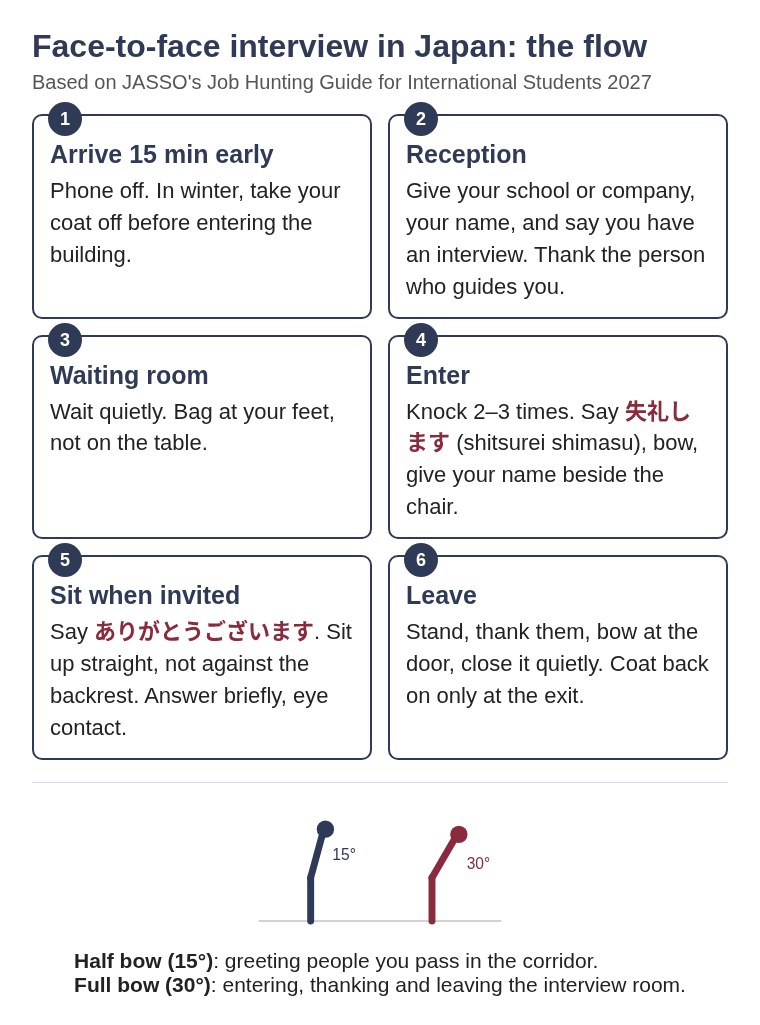
| Step | What to do | What to say | Why |
|---|---|---|---|
| 1. Arrival | Reach the venue about 15 minutes early. Turn your phone off before entering. In winter, take your coat off outside, fold it, and carry it over your arm. | — | Punctuality is treated as a basic professional skill; being early gives you time to calm down. |
| 2. Reception | Go to reception (or the floor phone) and state your school or company, name, and appointment. Thank the person who shows you the way, and bow lightly to staff you pass. | 「本日〇時から面接のお約束をいただいております、〇〇大学の〇〇と申します」 | JASSO advises assuming the interview starts at reception. The staff you meet are part of the company you want to join. |
| 3. Waiting room | Sit quietly with your bag at your feet, not on the table. Do not chat with other applicants or keep leaving the room. | — | You are still being observed. |
| 4. Entering | Knock two or three times. When you hear どうぞ, open the door, say the phrase, turn and close the door quietly, then bow once to the interviewers. | 「失礼します」 | Knocking announces you; waiting for permission and bowing show respect. |
| 5. Introducing yourself | Walk to the side of the chair, give your school or company and name, and bow again. | 「〇〇大学〇〇学部の〇〇と申します。本日はよろしくお願いいたします」 | You introduce yourself standing, before you are seated. |
| 6. Sitting | Sit only when invited. Bag at your feet. Sit slightly forward without leaning on the backrest. | 「失礼いたします」 | Waiting to be invited shows you respect the interviewer’s lead. |
| 7. During | Answer concisely in polite Japanese, with eye contact. In a group interview, listen when others answer. | If you did not catch a question: 「恐れ入りますが、もう一度お願いできますか」 | Interviewers judge your attitude as well as your answers. |
| 8. Leaving | Stand beside the chair and thank them, walk to the door, turn, bow, then leave and close the door quietly. Put your coat back on only after leaving the building. | 「本日はありがとうございました」 then 「失礼いたします」 | The last impression counts as much as the first. |
Bowing and posture
JASSO’s guide describes two bows for job hunting:
- Half bow, about 15°: for people you pass in the corridor, eyes on the floor about three metres ahead.
- Full bow, about 30°: the standard bow when entering, thanking and leaving, eyes on the floor about one metre ahead.
Bow from the waist with your back straight, and say the greeting before or after the bow rather than while bending. When seated, sit tall and forward in the chair without using the backrest. JASSO’s guide suggests women keep their legs together with hands on the knees, and men keep their legs slightly apart with hands resting lightly on the thighs. Keep your hands and feet still.
Polite Japanese you will need
You do not need perfect honorifics, but avoid casual words that sound careless in a business setting. JASSO lists these common corrections:
| Avoid | Use instead | Meaning |
|---|---|---|
| 僕、自分、俺 | 私、わたくし (watashi, watakushi) | I |
| そちらの会社 | 御社 (onsha) when speaking, 貴社 (kisha) in writing | your company |
| 了解しました | 承知しました (shōchi shimashita) | understood |
| わかりました | かしこまりました (kashikomarimashita) | certainly |
| ごめんなさい | 申し訳ございません (mōshiwake gozaimasen) | I am sorry |
Body language to avoid
- Crossing your arms or legs, or leaning back in the chair.
- Hands in your pockets, touching your hair or face, tapping a pen.
- Looking at your phone or watch.
- Speaking too quietly, or trailing off at the end of sentences.
- Strong gestures; keep hands still on your knees or thighs while you listen.
Your self-introduction and the end of the interview
Once seated, the first request is usually 「自己紹介をお願いします」 (“please introduce yourself”). Keep it to about a minute: your school or current job, what you studied or did, one thing you are proud of, and a closing 「よろしくお願いいたします」. Mid-career and foreign applicants can add when they came to Japan and their Japanese level in one sentence. For a one-minute template and example scripts, see Japanese self-introduction for job interviews; for other questions, Japanese job interview questions.
At the end you will almost always hear 「何か質問はありますか」 (“Do you have any questions?”). Saying “no” can look like low interest, so prepare one or two questions about the work:
- 「入社後の最初の1年は、どのような仕事を担当することが多いですか」 What work do new members usually do in their first year?
- 「チームは何名くらいで、どなたに報告する形になりますか」 How large is the team, and who would I report to?
- 「入社までに勉強しておくとよいことはありますか」 Is there anything I should study before joining?
Avoid opening with salary, holidays or overtime in a first-round interview; these are usually discussed later, at the offer stage or through a recruiter. Questions about working hours or business travel are fine if they genuinely affect your decision.
Two more habits help: start answers with はい (hai) to show you heard the question, and avoid fillers such as えっと (etto). A short pause to think is better than a filler.
Online interview etiquette
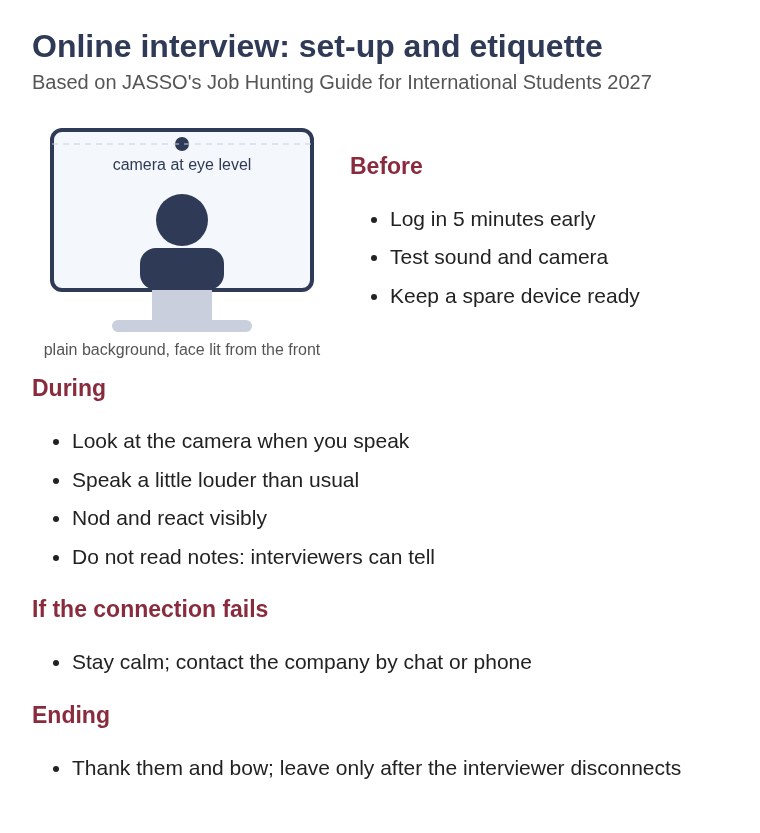
Online interviews follow the same manners, adapted to the screen. Dress as for a face-to-face interview, bow at the start and end, and keep notes out of sight. If the connection fails, do not panic; contact the company by the chat function or phone. For a recorded video interview (often 1 to 2 minutes on a set topic), you can usually retake it, but you should still dress and present yourself as for a real interview.
If you are running late
Call the company before your appointment time, explain briefly, give a new arrival time, apologise, and ask what they would like you to do. Based on the example in JASSO’s guide:
「お忙しいところ失礼いたします。本日〇時から面接のお約束をいただいております、〇〇大学の〇〇と申します。現在〇〇駅におりますが、電車が止まっており、到着が〇時ごろになりそうです。大変申し訳ございません。いかがいたしましょうか」
“Sorry to disturb you. This is ___ from ___ University; I have an interview with you at ___ today. I am at ___ Station, but the trains have stopped, and I expect to arrive at about ___. I am very sorry. How would you like me to proceed?”
JASSO also advises not calling early in the morning, late at night, or during lunch, calling from somewhere quiet, and waiting for the other person to hang up first.
After the interview
JASSO lists thanking a company for an interview as one of the uses of email in job hunting. A short email the same day is polite but not required; keep it brief, and do not repeat your whole application.
件名:本日の面接のお礼(〇〇大学 〇〇)
「本日はお忙しい中、面接の機会をいただき、誠にありがとうございました。〇〇のお話を伺い、貴社で働きたいという気持ちがいっそう強くなりました。引き続きどうぞよろしくお願いいたします」
Subject: Thank you for today’s interview (___ University, ___). “Thank you very much for taking the time to interview me today. Hearing about ___ made me even more eager to work at your company. I look forward to hearing from you.”
In writing, refer to the company as 貴社 (kisha); 御社 (onsha) is for speaking.
Common mistakes
| Mistake | Do this instead |
|---|---|
| Arriving at the reception desk 30 minutes early | Wait nearby and go to reception a few minutes before the time you were asked to arrive. |
| Sitting down as soon as you enter | Introduce yourself standing and wait for 「どうぞおかけください」. |
| Putting your bag on the chair or desk | Place it on the floor beside your feet. |
| Shaking hands | Bow. Shake hands only if the interviewer offers. |
| Guessing at a question you did not understand | Ask politely for it to be repeated. |
| Relaxing as soon as the questions end | Keep your manners until you have left the building. |
FAQ
How early should I arrive for a job interview in Japan?
JASSO advises arriving at the venue about 15 minutes before the appointed time so you can settle, and logging in about 5 minutes early for an online interview. Present yourself at reception at the time the company asked, not long before.
What is the “5-minute rule” in Japan?
It is an informal phrase, not an official rule. People usually mean being ready a few minutes before the start rather than exactly on time. For online interviews, JASSO’s advice is to log in five minutes early.
How many times should I knock?
Two or three times, according to JASSO’s guide. Wait for どうぞ before opening the door.
Should I bow or shake hands?
Bow. A handshake is fine only if the interviewer offers one, which is more common at foreign-owned companies.
Do I need to send a thank-you email after a Japanese interview?
It is not required, but a short email the same day is polite and is one of the uses of email that JASSO lists for job hunting. Use 貴社 in writing.
What are the five etiquette rules to remember?
Arrive early, treat reception as part of the interview, knock and wait to be invited in and to sit, use polite Japanese, and bow and thank the interviewers as you leave.
Sources
- Japan Student Services Organization (JASSO): Job Hunting Guide for International Students 2027 (English PDF). Interview process (face-to-face and online), bowing and posture, honorifics and business expressions, telephone and email etiquette.
- Immigration Services Agency of Japan: guide for foreign residents, Chapter 1 “Residence Card” (English PDF). Carrying the residence card at all times (age 16 and over).
For the whole hiring process, interview types and what interviewers assess, see the guide to Japanese job interviews. To rehearse the manners with a partner, see mock job interviews in Japan, and for what to say once you are seated, Japanese job interview questions.
Practise a Japanese interview with an AI interviewer
The practice tool is in Japanese only and is free to try: AI interview practice tool (Japanese).
Supervised by
河合 継, CEO, Crystal Method
An AI researcher and the inventor on 16 patents related to AI and deep learning, with past joint research with the National Cancer Center Japan and AI commentary on Japanese TV programmes. Leads AI research and development at Crystal Method.
About the company (Japanese) | Editorial policy (Japanese)
This page is general information about job hunting in Japan. Last reviewed: 21 October 2026.
Study about AI
AIについて学ぶ
-

PHP脆弱性へのAIセキュリティ対策——中小企業・自治体担当者の実務ガイド
2026年10月21日、PHPに重大な脆弱性2件が確認され、国内の多数のサービスが予防的なサービス停止を余儀なくされた。システム担当者にとって他人事ではない。P...
-
面接のロールプレイング(ロープレ)とは?選考で出る課題の流れと、練習のやり方
面接のロールプレイング(面接ロープレ)とは?まず結論から 面接のロールプレイング(面接ロープレ)は、主に2つの意味で使われます(面接をする側の練習として行うこと...
-

MiniMax M3.1 Flashでできること——機能・使いどころ・注意点を解説
MiniMax M3.1 Flashは、テキスト・画像・動画を入力として受け付け、100万トークンのコンテキストウィンドウと常時オンの推論機能を備えた大規模言語...