
ai-interview-practice
AI Interview Practice | Free AI mock interviews in Japanese
More interview practice, with
AI.
Questions tailored to your target company, generated by AI. Take mock interviews with the tension of the real thing and get an objective view of your speaking style, answers and even facial expressions. Free, as many times as you like.
Enter your details and start practicing right now.
Enter your target company and the questions will be tailored to that company.
Free-use conditions
- Cost: It’s free. Practice as many times as you like, with the same settings or with a different job type or target company.
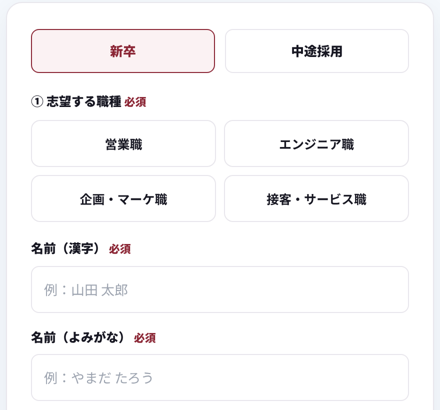
- What you enter: Required: new graduate or mid-career, desired job type, name, date of birth, gender, university, expected graduation date and email address. Your target company, and the work history and ES you can add on the confirmation screen, are optional.
- What you agree to: To start practicing, you need to agree to the Terms of Use, the Privacy Policy and the sharing of information with our partners (see the form below).
- What you need: A microphone is required; a camera is optional. Works in smartphone and PC browsers (a PC is recommended for stable practice).
- Length of one session: There are about 5 questions, plus follow-up questions based on your answers, so you’ll be asked about 8 questions in total.









What exactly is an AI interview?
It’s an interview method in which AI analyzes a candidate’s voice, video and answer text. For details on how it works and the evaluation criteria, see What is an AI interview? How it works, its benefits and how to choose [complete guide]. Here, let’s focus on gaining experience by actually trying it.
Interview practice: 3 hurdles
Many job seekers hit these hurdles and go into the real interview without enough practice.
No one to practice with
There’s no one nearby to run a mock interview, and you can’t do realistic practice alone.
Nerves on the day
Even after preparing, your mind goes blank in the real interview. Without enough practice, it’s hard to feel confident.
Not knowing your own habits
You can’t objectively spot weaknesses in your speaking, expressions or eye contact by yourself.
An interview made just for your target company.
Off-the-shelf lists of likely questions struggle with company-specific follow-ups such as “Why us?” or “How do you see our business?”. With this tool, when you enter your target company, its business, the kind of people it’s looking for and its latest developments are passed to the AI interviewer, which then asks questions that get into what makes the company distinctive. The more you practice, the further your company research goes.
Enter your target company
Just name the company you’re applying to
Proprietary company DB × RAG
Collects and passes on business details, desired candidate profile and latest developments
Company-specific follow-up questions
AI generates sharp questions made for that company
A real online interview,
recreated in your browser.
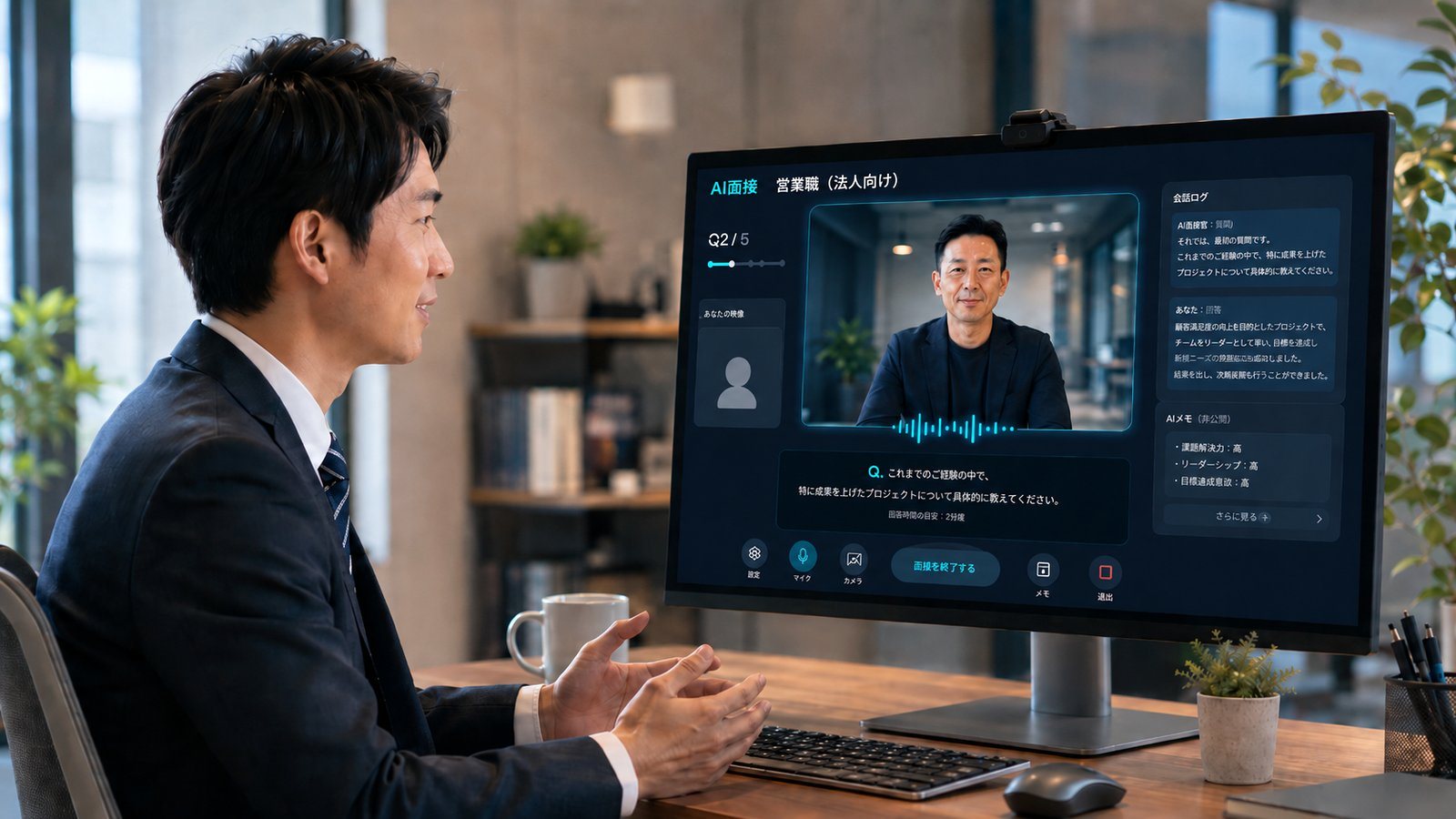
Practicing out loud on your own often leaves you unprepared for the unique atmosphere of a real interview: answering a stranger in real time, within a time limit. This tool has you practice through voice conversation with an AI avatar interviewer rather than text chat, so you can get used to that atmosphere in advance. Go in with plenty of practice behind you and your mind is less likely to go blank on the day.
- A realistic AI avatar asks questions out loud, with lifelike expressions and voice
- Elapsed time, remaining questions and subtitles shown in real time
- Practice your on-camera manner while watching your own video
Your speaking style and expressions,
visualized as data.
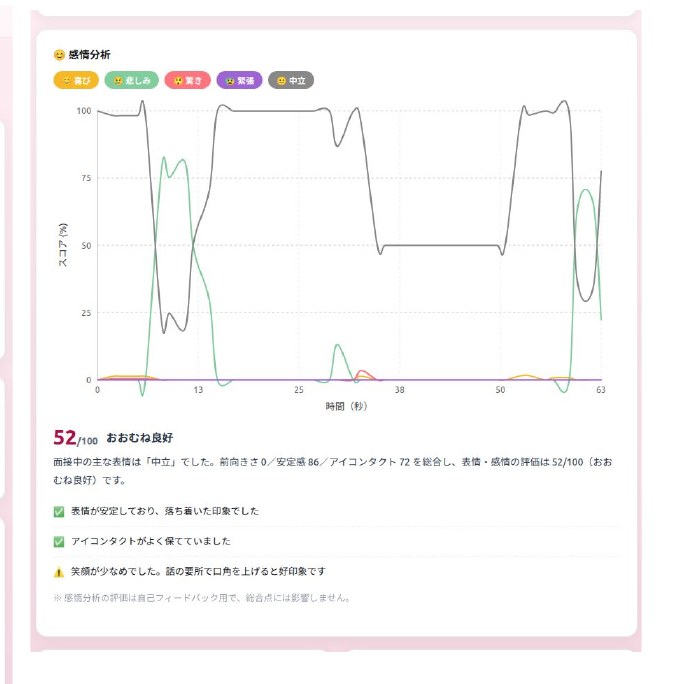
AI objectively analyzes the consistency of your answers, your speaking speed and how your eye contact and expressions change. Check habits you might not notice yourself through records rather than gut feeling. Audio and video are recorded during the interview, so you can watch them back afterwards to check your expressions and speaking style. Results are compiled in an evaluation report after the interview (see the sample below under “Sample evaluation report you receive after practice”).
- AI evaluates the consistency and logic of your answers
- Analyzes eye contact, expressions and speaking speed over time
- Specific feedback on “the one thing to fix next”
Job-specific real-world questions
For new graduates and mid-career candidates alike, the AI digs deeper from the perspective of your desired job type.
Sales
Probes customer focus, proposals and negotiation
Engineering
Evaluates technical understanding and clear, logical explanation
Planning & marketing
Asks about problem framing and planning skills
Customer service & hospitality
Checks adaptability and hospitality
What each job type’s practice focuses on, with example questions
The questions below are examples to give you a sense of what’s assessed in practice (they are not the actual questions asked). Try answering out loud in the order “conclusion → reason → concrete example”.
- Sales: “Have you ever drawn out someone’s needs and changed your proposal as a result?” “When you’re turned down, what do you do next?”
- Engineering: “How would you explain something technical to a non-specialist?” “Tell us about the hardest part of a development project and how you solved it.”
- Planning & marketing: “Given a problem, how would you sort out its causes, and where would you start?” “Tell us about a time you made a decision based on numbers.”
- Customer service & hospitality: “How do you respond when you can’t meet a customer’s request?” “How do you prioritize during busy periods?”
3 steps and you’re practicing
Enter your details
Just enter your job type, target company and ES (optional). You’ll be ready in no time.
Interview with AI
A realistic voice interview with an avatar interviewer. Elapsed time and remaining questions are shown.
Review and improve
See your strengths and areas to improve. Try again as often as you like, with the same or new settings.
The evaluation you get after practice, with examples of how to improve
How to go about practicing is covered in Interview practice you can do on your own, and sample answers for each question in The complete guide to interview preparation. Here, we look at what you get back after practicing with this tool.
Sample evaluation report you receive after practice
In AI Interview Practice, when the interview ends you see scores on 4 job-specific evaluation criteria, an overall score out of 100, and a summary, strengths and areas to improve. Knowing what to fix next, you can practice again with the same settings and check how you’ve changed.
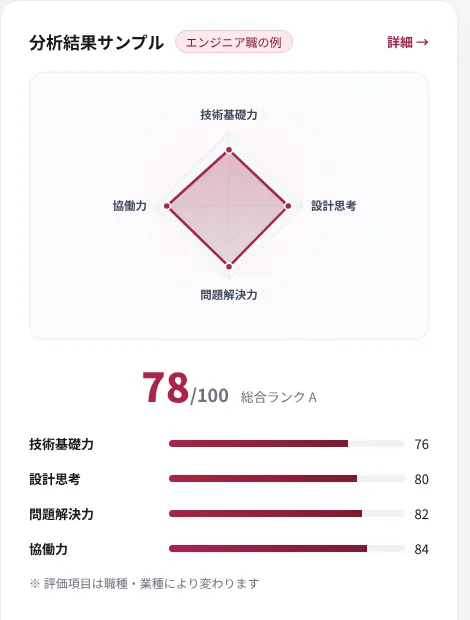
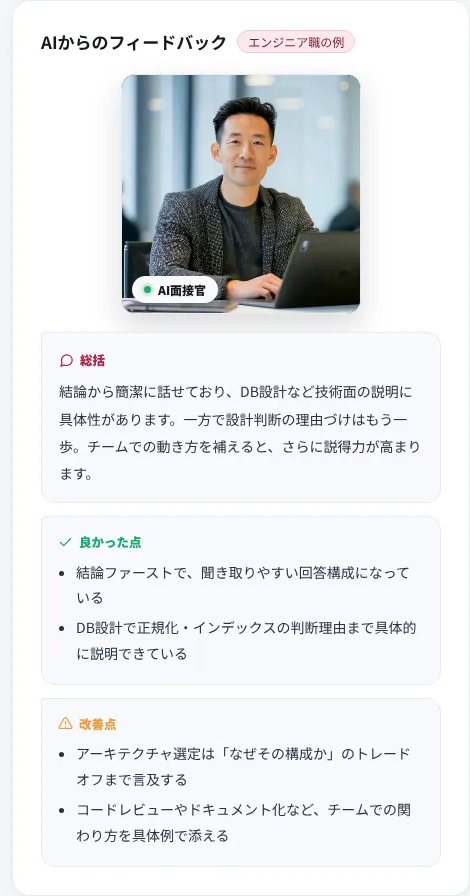
The evaluation criteria depend on the job type. For engineering, as in the sample above, there are 4: “technical fundamentals, design thinking, problem solving and collaboration”; for customer service & hospitality, criteria such as “cleanliness and hygiene awareness” appear, reflecting what interviewers for that job look for. The most common area to improve is “specificity (episodes and numbers)”, accounting for about 53% of all feedback points (based on practice records from June to October 2026).
Common feedback points and how to fix them
Broken down by type, the improvement points returned in practice are most common in the following order (from practice records June–October 2026, tallied by the AI’s automatic evaluation; top 5 types).
| Feedback type | Share | How to fix it |
|---|---|---|
| Specificity (episodes, numbers) | About 53% | Include one example: when, with whom, what you did, and how the result changed |
| Depth of reasoning | About 10% | Be ready to say “why you did it” in one sentence |
| Structure | About 9% | Order it as conclusion → reason → example → what you’ll do after joining |
| Clear conclusion | About 8% | Answer the question outright in your first sentence |
| Motivation & company understanding | About 6% | Link your reason for choosing the company to its business and the people it’s looking for |
The most common issue, “specificity”, can be fixed like this (the answers are examples created for illustration).
| Answer that gets flagged | “I worked hard as a leader in my club.” |
| Improved answer | “New members kept quitting, so I set up a weekly practice day for beginners. I kept reaching out to the new members who came, and the following term, fewer people quit.” |
The AI’s scores and comments don’t predict whether you’ll pass; they’re a guide to finding what to fix next. Rather than the score itself, look at how the feedback changes after you revise your answer to the same question.
What to know before using an AI mock interview
How to use it for different types of interviews
This tool covers new-graduate and mid-career interviews, for 4 job types: sales, engineering, planning & marketing, and customer service & hospitality. Enter your target company and you’ll get questions tailored to it. Other types of interviews ask different things, so combine the tool with the articles below.
| Interview type | Practicing with this tool | Further reading |
|---|---|---|
| New-graduate job hunting | Practice by selecting “New graduate” | Interview tips for new graduates |
| Changing jobs (mid-career) | Practice by selecting “Mid-career”. If you enter your work history on the confirmation screen, the interviewer will dig into it | Interview tips for changing jobs |
| University admissions (recommendation / comprehensive selection) | No dedicated category | Practice university admission interviews with AI |
| Civil service exams | No dedicated category | Interview tips for civil service exams |
| Part-time jobs | No dedicated category | Part-time job interview questions and how to answer |
The order for combining AI and human practice
We recommend this order: do repeated AI mock interviews, fixing the improvement points in your evaluation report one at a time (aim for at least 10 minutes per session), then finally check the impression your answers make in a mock interview with a person, such as at your university career center, Hello Work (Japan’s public employment service) or a recruitment agency. Don’t just watch your recordings back: transcribe the audio and count your filler words (“um”, “uh”) and the length of each answer (around 1 minute is a good guide), so the points to fix become concrete. For how to record yourself, see Interview practice you can do on your own、Interview practice at Hello Work.
How to practice interviews with general-purpose AI such as ChatGPT
Conversational AIs such as ChatGPT, Gemini and Claude can also be practice partners if you ask them to play the interviewer. However, the number of questions, time limits and evaluation criteria won’t be set unless you specify them yourself. Asking like this lets you practice in a flow close to the real thing (replace the 〇〇 parts with your own details).
How to ask for a new-graduate interview
You are an HR interviewer at 〇〇 Co., Ltd. I am a new graduate applying for a sales position. ・Ask one question at a time. After I answer, ask one follow-up question that digs into the concrete episode in my answer. ・After 5 questions, tell me what I did well and what to fix on 3 points: "Did I lead with my conclusion?", "Did I give concrete episodes or numbers?" and "Does my motivation fit this company?" ・Now, please start with the first question.
How to ask for a career-change (mid-career) interview
You are a team manager at 〇〇 Co., Ltd. and a mid-career hiring interviewer. I'll paste my work history below. ・Ask me questions one at a time, focusing on the evidence behind my achievements and experiences that didn't go well. ・Be sure to also ask why I'm changing jobs and what I want to do after joining. ・Finally, tell me 3 points where I scored highly and 3 where my answers were weak. (Paste your work history here)
Don’t include company secrets or other people’s personal information in the work history or ES you paste into a general-purpose AI. If you want to practice answering out loud or get a job-specific evaluation report, use AI Interview Practice on this page.
How recordings and the information you enter are handled
Before you start practicing, check what is saved and how it is used.Privacy Policy states the following.
- Audio and video during practice are used to analyze your expressions and speaking style, and for recordings you can review later. Only the microphone is required; the camera is optional.
- What you enter, such as your name, email address and school, along with the interview dialogue and evaluation results, is saved. Your email address is used to identify you so you can pick up where you left off.
- To start practicing, you must agree to your information being shared with our partners (which may include companies outside Japan). Within the scope you agree to, the information is shared so they can tell you about job and career opportunities.
- You can request deletion of saved information by contacting info@crystal-method.com.
FAQ
Start practicing today for your real interview.
“It’s hard to practice alone.” “I get nervous in the real interview.” If that sounds like you, you can practice in a realistic format as many times as you like. Start with a free session.
AI News