
mock-job-interview-japan
Mock Job Interviews in Japan: Where to Practise and How to Do One (Including on Your Own)
A mock job interview (模擬面接, mogi mensetsu) is a practice interview run like the real thing: someone plays the interviewer, asks typical questions, and tells you afterwards what to fix. In Japan you can get one free at your university career centre, at the government’s Employment Service Centers for Foreigners and Hello Work, through recruitment agencies, or on your own with a phone camera or an AI interviewer. The value is not the practice itself but the review: one or two concrete things to change before the real interview.
- University career centre: mock interviews and entry-sheet advice for students. Some universities run programmes with company HR staff for international students.
- Tokyo Employment Service Center for Foreigners: an interview practice seminar with staff playing the interviewer (in Japanese, for N2 level and above, Hello Work registration required).
- Recruitment agencies: often prepare registered candidates for a specific company’s interview.
- On your own: record yourself on a phone, or use an AI interviewer. Crystal Method’s AI tool is free but Japanese only.
What is a mock interview in Japan?
In Japanese job hunting, the mock interview is a standard step. JASSO’s job hunting guide for international students recommends asking a friend or a university career counsellor to act as the interviewer, because you feel the same nerves as in the real interview and get advice on what was good and what to improve. It follows the full Japanese format, from knocking on the door to leaving the room, so manners are practised along with answers.
It is different from simply reading a list of questions. A good mock interviewer asks follow-up questions (“Why did you choose that approach?”, “What did you do yourself?”), which is where most real interviews are decided.
Why do a mock interview?
The gap most people need to close is specificity. In Crystal Method’s AI interview practice tool (Japanese-language sessions from 26 June to 11 October 2026, scored automatically by AI), about 53% of the improvement points concerned missing specifics such as episodes or numbers. Explaining the reason behind an answer (about 10%), structure (about 9%) and stating the conclusion clearly (about 8%) came next. These are exactly the problems a mock interview exposes.
Where to get a mock interview
| Where | Who it suits | What you get | Points to know |
|---|---|---|---|
| University career centre or international office | Students in Japan | Mock interviews, entry-sheet and resume checks (JASSO recommends using them often) | Book early in the job hunting season. Some universities run special programmes; Kyoto University’s graduate division, for example, has offered mock interviews with HR staff from Japanese companies for international students. |
| Tokyo Employment Service Center for Foreigners | Foreign students and graduates job hunting in Japan | A beginner seminar on interview manners, a motivation seminar, and an interview practice seminar where staff play the interviewer | Held in Japanese; the practice and motivation seminars are for N2 level and above. Book by phone. You must be registered as a job seeker at Hello Work. |
| Hello Work (public employment office) | Anyone looking for work in Japan | Employment counselling; ask your office about interview advice | Foreign-language phone support in all 47 prefectures and interpreters in some offices (JASSO). Other centres for foreigners are in Osaka, Nagoya and Fukuoka. |
| Recruitment agency | Mid-career and specialist applicants | Preparation for a specific company’s interview | Usually only for candidates the agency is putting forward. |
| Friend or classmate | Anyone | Realistic nerves, quick repetition | Give them your question list and ask for blunt feedback, ideally a Japanese speaker. |
| On your own (phone or AI) | Anyone, any time, including from overseas | Unlimited repetition; a recording to review, or automatic feedback | No human judgement of manners; combine with at least one human mock interview. |
How a mock interview works: three steps
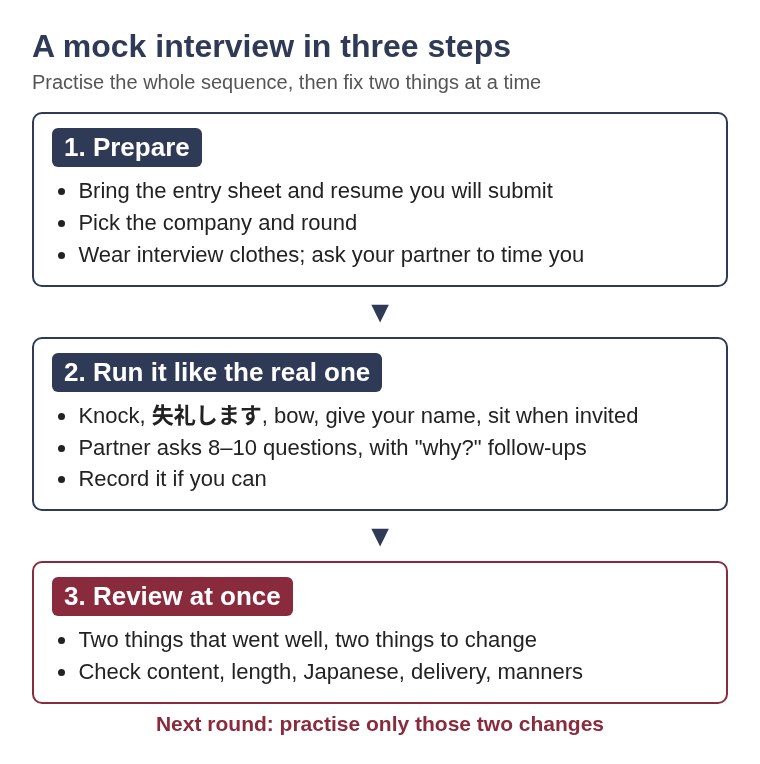
Step 1: Prepare like the real one
- Bring the entry sheet and resume you will actually submit; the interviewer will ask from them.
- Choose the company and round you are preparing for (a first-round group interview is different from a final one).
- Wear your interview clothes. The Tokyo centre asks participants to dress as close to the real thing as possible.
- Ask the interviewer to time your answers and note filler words.
Step 2: On the day, from entering to leaving
Run the whole sequence: knock two or three times, say 失礼します (shitsurei shimasu), bow, give your name beside the chair, sit when invited, answer, thank the interviewer and leave. The guide to Japanese job interviews has a diagram of the six steps and the two bows.
Step 3: Review straight away
Ask for two things that went well and two things to change, and write them down before you forget. Then practise only those two changes in the next round.
What Japanese employers are judging
Your partner should judge you the way a Japanese company would. JASSO’s guide says that, especially for new graduates, companies emphasise character, cooperation and adaptability, and look at fit with their culture, alongside your reason for applying and self-promotion. Many companies hire for the long term and train people over years, so they also listen for signs that you will stay. For foreign applicants, listening and speaking in Japanese are assessed throughout.
Question sheet for your mock interviewer
Give this sheet to the person playing the interviewer. It tells them what to ask, what a good answer contains, and what to flag. For all 22 common questions with full example answers, see Japanese job interview questions.
| Ask (Japanese) | A good answer has | Flag if |
|---|---|---|
| 自己紹介をお願いします Introduce yourself |
Four parts in about a minute: name and school or job, what you studied or did, one thing you worked hard on, a short greeting. | It turns into a life story or repeats the whole resume. |
| 志望動機を教えてください Why our company? |
What you want to do, the experience behind it, and something only this company offers. | The answer would work for any company in the industry. |
| 学生時代に力を入れたことは何ですか What did you work hardest on? |
One episode: the situation, your own action, the result with a number, what you learned. | No number, or “we” throughout with no clear personal role. |
| チームで取り組んだ経験は Working in a team |
The team’s goal, your role, how you handled a disagreement. | You come across as doing everything alone. |
| 長所と短所は何ですか Strengths and weaknesses |
A strength backed by an episode; a real weakness and what you do about it. | The weakness is a disguised strength (“I work too hard”). |
| 5年後どうなっていたいですか Five years from now |
A goal you can reach inside this company. | It suggests you will leave Japan or the company soon, without a plan. |
| 当社について知っていることは What do you know about us? |
Two facts from research (mission, a main product, recent news) and why they matter to you. | Only what is on the first page of the website. |
| 希望年収はありますか Expected salary |
New graduates: 御社の規定に従います (“I will follow your pay scale”). Mid-career: a range based on current pay. | A single high number with no reason. |
| 最後に何か質問はありますか Any questions for us? |
One or two questions about the work, e.g. 入社までに勉強しておくとよいことはありますか (“Is there anything I should study before joining?”). | “No questions”, or a first question about holidays. |
Foreign applicants should add three questions to the sheet: なぜ日本で働きたいのですか (why Japan), 日本語はどのくらい話せますか (Japanese level) and 日本にはどのくらい住む予定ですか (how long you plan to stay). Your partner should flag a vague reason such as “I like Japanese culture”.
Self-introduction your partner can compare against (written for this guide):
「〇〇大学工学部4年の〇〇と申します。大学では水処理の研究をしており、地域の浄水場で実地調査を行いました。サークルでは留学生向けの日本語交流会を企画し、参加者を1年で2倍に増やしました。本日はよろしくお願いいたします」
“My name is ___, a fourth-year engineering student at ___ University. I research water treatment and carried out field surveys at a local water plant. In my club I organise Japanese conversation events for international students and doubled attendance in a year. Thank you for your time today.”
More model answers to compare against (same applicant, written for this guide):
志望動機 (why us): 「御社を志望するのは、水処理の技術で海外のインフラ整備に関わりたいからです。浄水場の調査で、設備の点検を少ない人数で回す難しさを知りました。御社は東南アジアで浄水設備の保守を手がけているため、研究で学んだことを現地で生かせると考えています」
“I want to join you because I want to use water treatment technology in overseas infrastructure. Surveying a water plant, I saw how hard it is to inspect equipment with few staff. You maintain treatment plants in Southeast Asia, so I could apply my research on site.”
長所と短所 (strength and weakness): 「長所は、地道な記録を続けられることです。調査では3か月間、毎日水質を記録し、異常の傾向を見つけました。短所は、人に頼るのが遅いことです。今は、半日考えて分からなければ先輩に聞くと決めています」
“My strength is keeping careful records over time: I logged water quality every day for three months and found a pattern in the anomalies. My weakness is asking for help too late; now, if I am stuck for half a day, I ask a senior colleague.”
5年後 (five years): 「5年後には、海外の案件で現地スタッフと日本の技術者をつなぐ担当になりたいです。まずは国内の現場で保守の基本を身につけます」
“In five years I want to be the person connecting local staff and Japanese engineers on overseas projects. First I will learn maintenance on sites in Japan.”
逆質問 (questions for them): 「若手のうちに海外の現場に行く機会はありますか」「配属後の最初の1年は、どのように仕事を覚えていくことが多いですか」「評価では、どのような点が重視されますか」
“Do junior staff get chances to work on overseas sites?” “How do new members usually learn the job in their first year?” “What is valued most in performance reviews?”
Mid-career and practical questions to add: 前職を辞めた理由は (why you left; answer forward-looking, no complaints), いつから働けますか (when you can start, including any change of residence status), 残業はできますか (overtime; yes when needed, and ask how often). If you did not catch a question, practise asking: 「恐れ入りますが、もう一度お願いできますか」 (“Sorry, could you say that again?”).
What to check when you review
| Area | Check |
|---|---|
| Content | Did each answer start with a one-sentence conclusion? Was there one specific episode, with a number where possible? Did it match the entry sheet? |
| Follow-ups | When asked “why?” or “what did you do yourself?”, could you go one level deeper without contradicting yourself? |
| Length | About one minute per answer? Self-introduction within the time given? |
| Japanese | Polite desu/masu throughout? Fillers such as えっと (etto) or あの (ano)? Did you ask for a repeat politely when you did not understand? |
| Delivery | Eye contact, volume, speed, posture (not leaning back), hands still. |
| Manners | Knock, greeting, waiting to be seated, thanks and bow at the end. |
How to do a mock interview on your own
With a smartphone
- Write ten likely questions on cards and shuffle them.
- Set the phone at eye level, sit as you would in the interview, and record.
- Draw a card, answer without notes, and move to the next card without stopping the recording.
- Watch the video and use the review table above. JASSO suggests checking eye contact, clarity of speech and language.
- Redo only the weakest two answers, then record the whole set again.
With an AI interviewer
An AI interviewer adds what a phone cannot: unexpected follow-up questions and written feedback. Crystal Method’s AI interview practice tool lets you choose the company and job type, talk with an AI interviewer by voice, and then shows a score and feedback. The tool is in Japanese only (screens, questions, voice and feedback); there is no English mode, so use it when you are preparing for an interview in Japanese.
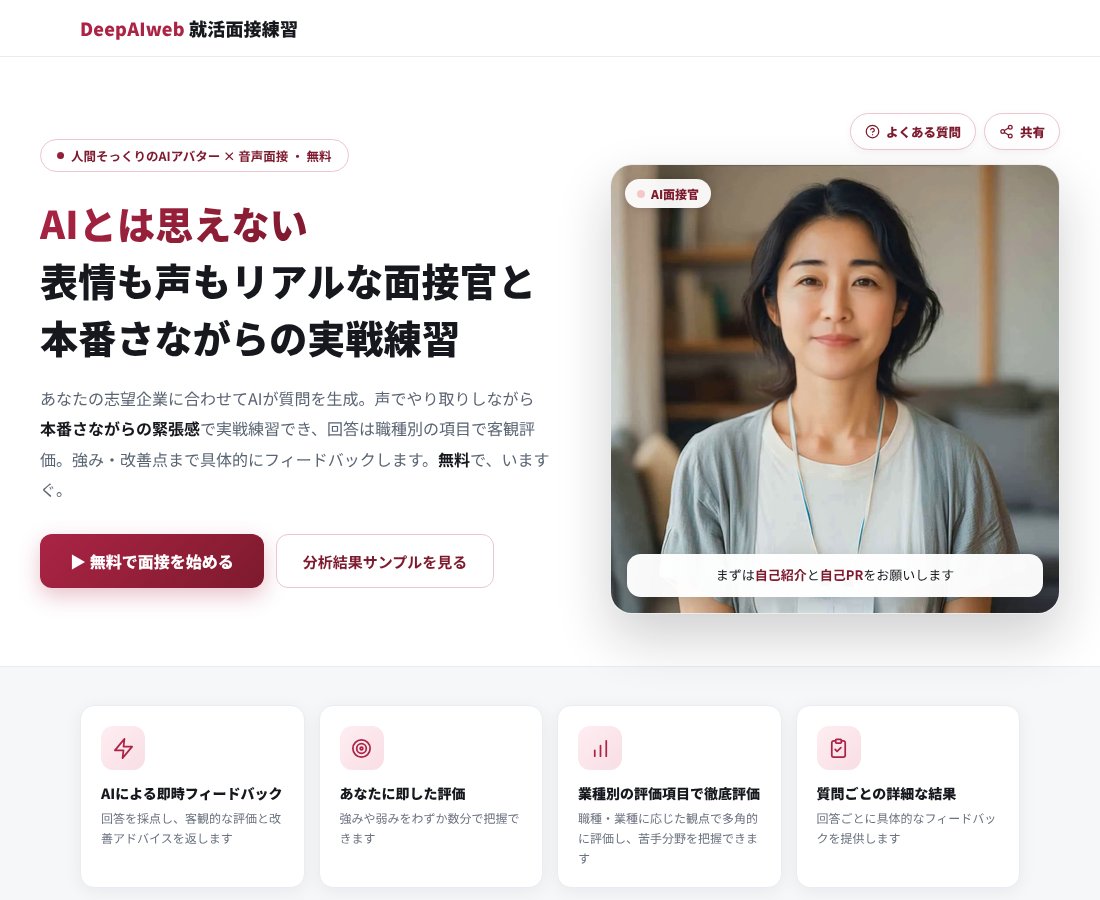
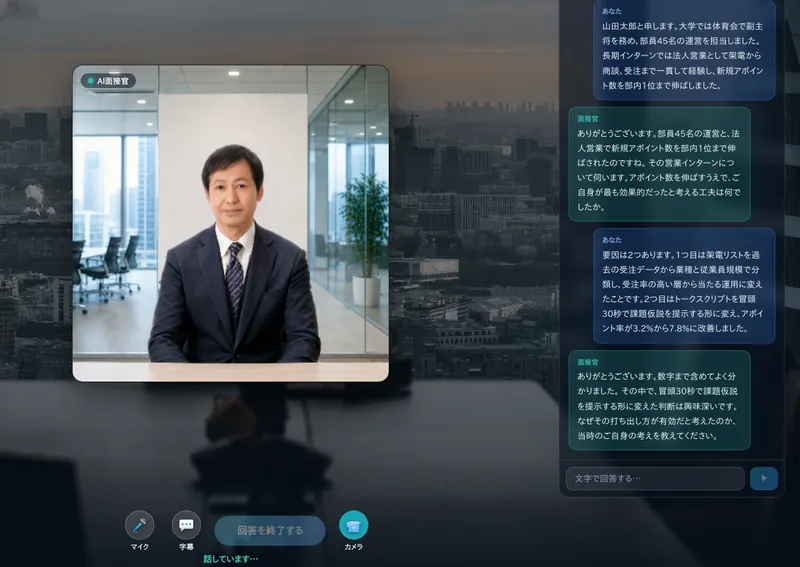
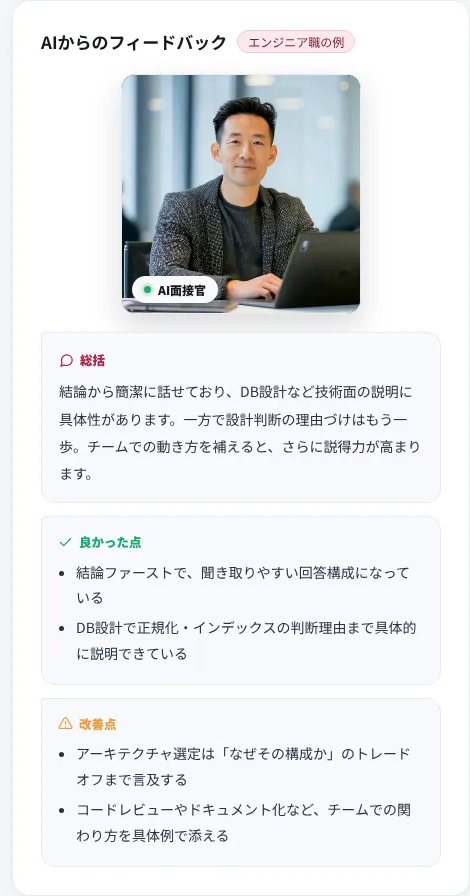
Two findings from the same usage data are worth knowing before you start:
- Use a computer. The share of sessions completed was about 49% on PCs but about 19% on smartphones.
- Do a full-length session. Completed sessions of 10 minutes or more had a median overall score of 54.6, against 13 for sessions of 1 to 3 minutes. Short sessions end before the follow-up questions start.
Practice script: a first-round interview
Use this short script with a friend playing the interviewer. It is written for this guide and shows how a follow-up question works. The interviewer should keep asking “why” until the answer becomes specific.
面接官: 「学生時代に力を入れたことを教えてください」
Interviewer: “Tell me what you put the most effort into as a student.”
You: 「留学生会の会計として、イベント費用の管理方法を変えたことです」
“As treasurer of the international students’ association, I changed how we managed event costs.”
面接官: 「なぜ変えようと思ったのですか」
“Why did you decide to change it?”
You: 「毎回予算を超えていたのに、理由が誰にも分からなかったからです。領収書の紛失が原因だと考え、写真で記録する共有表を作りました」
“We went over budget every time and nobody knew why. I thought lost receipts were the cause, so I set up a shared sheet where we recorded receipts by photo.”
面接官: 「周りの反対はありませんでしたか」
“Did anyone object?”
You: 「最初は手間だという声がありました。そこで、記録が1分で終わるように項目を3つに減らしました。翌年は予算内で運営できました」
“At first some said it was too much work, so I cut the fields to three so it took a minute. The next year we stayed within budget.”
Try the same script with three interviewer styles: a friendly one who nods, a neutral one who shows no reaction, and one who asks “why?” after every answer. Real Japanese interviewers vary, and the neutral style unsettles many applicants the first time.
FAQ
What will be asked in a mock interview?
The same questions as a real first or second round: self-introduction, reason for applying, what you worked hardest on, strengths and weaknesses, and questions for the company, plus follow-up questions on your answers. Foreign applicants should also prepare for “why Japan”, Japanese level and how long they plan to stay.
Can I do a mock interview in English in Japan?
The government seminars described above are held in Japanese, and Crystal Method’s AI tool is Japanese only. If your real interview will be in English, practise with a friend, your university career centre or an agency handling English-speaking roles.
Are mock interviews free in Japan?
University career centres and public employment services such as Hello Work and the Employment Service Centers for Foreigners do not charge job seekers. Kyoto University’s programme for international students is advertised as free participation. Private coaching services may charge.
How many mock interviews should I do?
Enough to fix the problems the first one reveals. A practical pattern is one human mock interview, then several recorded or AI sessions to fix the two biggest issues, then a final human mock interview before the real one.
How hard is it for a US citizen or other foreigner to get a job in Japan?
It depends mainly on your Japanese and your field. JASSO reports that about 70% of companies want business-intermediate Japanese or higher at the job-offer stage. You also need a status of residence that permits the work. Roles that use English or specialist skills widen your options.
Sources
- Japan Student Services Organization (JASSO): Job Hunting Guide for International Students 2027 (English PDF). Practising alone and with others, support centres, Japanese level sought by companies.
- Tokyo Employment Service Center for Foreigners (Tokyo Labour Bureau): seminars for job seekers (Japanese) and English page
- Kyoto University, Division of Graduate Studies: Practice Mock Interviews with HR, Japan Career Training Program
- Crystal Method AI interview practice tool: usage data from 26 June to 11 October 2026 (Japanese-language sessions, automatic AI scoring). Percentages only; the data is not limited to foreign users.
Try a mock interview with an AI interviewer
The practice tool is in Japanese only and is free to try: AI interview practice tool (Japanese).
Supervised by
河合 継, CEO, Crystal Method
An AI researcher and the inventor on 16 patents related to AI and deep learning, with past joint research with the National Cancer Center Japan and AI commentary on Japanese TV programmes. Leads AI research and development at Crystal Method.
About the company (Japanese) | Editorial policy (Japanese)
This page is general information about job hunting in Japan. Last reviewed: 21 October 2026.
Study about AI
AIについて学ぶ
-

PHP脆弱性へのAIセキュリティ対策——中小企業・自治体担当者の実務ガイド
2026年10月21日、PHPに重大な脆弱性2件が確認され、国内の多数のサービスが予防的なサービス停止を余儀なくされた。システム担当者にとって他人事ではない。P...
-

面接のロールプレイング(ロープレ)とは?選考で出る課題の流れと、練習のやり方
面接のロールプレイング(面接ロープレ)とは?まず結論から 面接のロールプレイング(面接ロープレ)は、主に2つの意味で使われます(面接をする側の練習として行うこと...
-

MiniMax M3.1 Flashでできること——機能・使いどころ・注意点を解説
MiniMax M3.1 Flashは、テキスト・画像・動画を入力として受け付け、100万トークンのコンテキストウィンドウと常時オンの推論機能を備えた大規模言語...