
ai-role-play
AI Role-play | AI training for sales and customer-harassment response

AI role-play for sales and customer-harassment training
Get more sales practice with
AI.
DeepAI Conversational AI Role-play is an AI role-play tool for businesses: trainees practice sales meetings, customer service and complaint handling with an AI avatar, and get scored on what they said, their voice, facial expressions and the materials they showed as soon as the session ends (for sales, customer service and customer-harassment training). Because practice can be repeated 24/7, 365 days a year, without depending on anyone’s schedule, each person’s weak points become visible as numbers, and everyone in the organization gets practice against the same standard.
Demo video
Demo recording of customer-harassment AI role-play (the customer’s voice is AI-synthesized)
What is AI role-play? | A training tool where AI plays the counterpart and scores you
AI role-play is a training method in which AI plays the counterpart, such as a customer, manager or interviewer, and scores the trainee’s responses right after the conversation ends. Unlike traditional role-play with a human counterpart, there is no need to arrange someone to play the role, and everyone is evaluated against the same criteria.
- Counterpart: An AI avatar responds with voice and facial expressions, and the conversation adapts to how the trainee speaks.
- Scoring: Scored right after the session on four axes: what was said, voice, facial expressions and the materials shown.
- Scenarios: Choose from hundreds of scenarios, including sales, customer service, call center, customer-harassment handling and interviews.
- For admins: Review results for a team or all trainees together in the admin console (login required).
For a detailed look at how AI role-play generally works and how to roll it out, see What is AI role-play? How to use it in sales, customer service and training.
What is AI sales role-play? | How it differs from role-play with a person
AI sales role-play is a setup in which AI plays the customer, so you can practice sales situations such as cold calls, initial discovery, proposals, objection handling and closing as many times as you like, regardless of anyone else’s schedule. Sales role-play comes down to two things: speaking with tension close to the real thing, and reviewing concretely, right afterwards, what went well and what didn’t. AI delivers the latter every time against the same standard, by scoring what you said, your voice, facial expressions and the materials you showed.
The goal of sales role-play is not memorizing talk scripts in itself, but three things: (1) noticing your own weak points (insufficient discovery, weakness against objections, soft closing, etc.); (2) cementing product knowledge and comebacks by actually saying them out loud; and (3) aligning the team on what a “good sales meeting” looks like. AI increases the amount of practice for (1) and (2), and provides shared scoring criteria for (3).
For how evaluation works and why it improves sales skills, see What is AI sales role-play? | How evaluation works and why sales skills improve .
The counterpart is an AI avatar | Choose the situation and persona, and practice as often as you like
Choose a scenario and an AI avatar plays the customer. You can build the counterpart’s persona to match your product and customer setting (for example, a section manager in charge of purchasing supplies at a hospital), so you can focus on repeating only the situations you find hard, such as “comebacks after being turned down” or “answering when asked about price.” The counterpart is available 24/7, 365 days a year, to the same standard, and you can practice on a PC or smartphone.
Scoring gives both scores and the reasons for deductions
Sales evaluations give a score for each criterion: discovery, knowledge and evidence, objection handling, closing, delivery quality and compliance. For each statement that lost points, it shows which statement it was and why, with reasons; voice (intonation, volume, speaking rate, pronunciation) and facial expressions (changes in composure) are recorded along the speech timeline. You can pinpoint what to fix without relying on a senior colleague’s impressions.
Practice sales meetings where you present materials
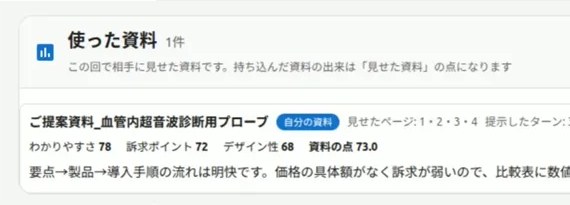
Load your usual sales materials (PDFs, etc.) and talk while showing your proposal, and the AI counterpart asks questions based on the pages you showed. Afterwards, each material is scored on when it was shown, clarity, key selling points and design. Being able to review even how your materials are built within the same practice session is what sets it apart from text-only AI chat.
Sales situations you can practice | From cold calls to post-contract follow-up
Practice by setting up a counterpart for each situation along the sales process. The table below shows example settings for creating scenarios. Actual scenarios are built to match your own products and customer profiles.
| Situation | Example AI counterpart settings | What the practice checks |
|---|---|---|
| Cold calls | A receptionist who asks what the call is about / a busy decision-maker who wants the point in 30 seconds | Can you get from introducing yourself to your purpose briefly? Can you turn a rejection into a next appointment? |
| Discovery on the first visit | A contact who doesn’t clearly state their issues and has no major complaints about their current supplier | Can you draw out their problems, budget, decision process and timing with questions that can’t be answered with yes or no? |
| Proposals and presentations | A contact who looks through the materials and checks whether they fit their company’s situation | Can you connect your proposal to their issues? The order and timing of showing materials |
| Objection handling and price negotiation | A counterpart who says “It’s expensive,” “Another company is cheaper” or “Now isn’t the right time” | Do you ask the reason for the objection before answering? Can you explain the value before discounting? |
| Closing | A counterpart who is positive but can’t commit, citing internal approval processes | Can you decide on the spot what happens next, who does it and by when? |
| Post-contract follow-up and upselling | An existing customer who has started to have minor complaints after starting to use the product | Can you hear out their complaints fully before moving on to an additional proposal? |
How AI plays the customer
Voice-based AI role-play generally works like this:
- The trainee’s voice is transcribed (speech recognition)
- A large language model (LLM) works out the next reply based on the counterpart’s persona defined in the scenario, product information and the conversation so far
- The reply is turned into speech (speech synthesis) and the avatar speaks it
- After the session, the conversation log is evaluated against the scoring criteria, and scores and the reasons for deductions are returned
This is why the counterpart “acts within the range you set.” The more detailed the persona and product information written into the scenario, the closer the replies get to real customers.
4 things to check when choosing AI sales role-play
| Check | What to look at | DeepAI Conversational AI Role-play (this page) |
|---|---|---|
| Scenarios | Can you build a counterpart that matches your products and customer profiles? Ready-made situations alone drift from real sales meetings | We create a dedicated scenario with your product information and customer settings through hearings (can be introduced in as little as about 1 week) |
| What gets scored | Are reasons for deductions shown per statement, not just scores? Are voice, facial expressions and materials covered too? | Statements, voice, facial expressions and materials shown are scored in one report, with reasons for deductions |
| Admin features | Can admins track the progress of multiple people? Is history kept? | History is saved in the cloud, and each member’s progress can be viewed as graphs in the admin console |
| Data handling | Are sales information and audio reused for training? Where is the data stored? | Communications are encrypted and data is managed in a domestic (Japan) cloud. Sales information and audio are not reused for training |
For differences in features, pricing and evaluation targets, including other vendors’ services, see Comparing and choosing AI role-play tools .
What AI sales role-play alone can’t cover
AI excels at playing the counterpart with the same quality as many times as needed within a fixed setting, and at keeping scoring consistent. On the other hand, the following points should be supplemented with human role-play and real sales meetings.
- The counterpart’s persona acts within the range you set.It can’t reproduce a real customer’s internal circumstances or history, so pre-meeting research remains the salesperson’s job.
- You need to check that the scoring criteria match the purpose of the practice.So that raising scores doesn’t become the goal in itself, align the team in advance on what counts as a pass.
- Senior colleagues’ and managers’ experience has value apart from AI scoring.A realistic division of roles: use AI scoring to narrow down what to fix, and talk with managers about the reasoning behind decisions and customer-specific know-how.
Do these challenges sound familiar?
Training depends on individuals, and coaching resources are limited
In many workplaces, managers don’t have time to act as role-play partners, so training is left to the front line and depends on individuals. Failing to build a consistent training system leads to big differences in how quickly new hires develop, which is the biggest bottleneck in growing an organization.
With AI as the counterpart, you can give every employee the same level of practice opportunities without worrying about coaches’ time.

CASE 01: LACK OF TRAINING RESOURCES
Lack of tension from practicing with familiar colleagues
Practice among colleagues inevitably gets lenient and can’t reproduce the real “fear of rejection” or “difficulty of comebacks.” When practice becomes a formality, new hires are thrown by the gap the moment they go into the field, which can even lead to them leaving.
The AI counterpart doesn’t hold back from refusing, doubting or getting angry, so trainees can practice with tension close to the real thing that’s hard to get in internal practice.

CASE 02: LACK OF REALISTIC INTENSITY
Vague evaluation criteria and unconvincing feedback
Abstract feedback based on a coach’s subjective view, like “That was good” or “Be a bit more confident,” doesn’t convey what specifically to fix. When evaluation criteria become a black box, members lose motivation.
By returning statements, voice and facial expressions as numbers with reasons, coaching shifts to data trainees can accept, speeding up the cycle of review and retry.

CASE 03: VAGUE EVALUATION STANDARDS
What is scored, and how | Four axes: statements, voice, facial expressions and materials

Visualize facial expressions, emotions and tension along the speech timeline
Facial expressions, emotions and tension are visualized over time along the speech timeline. You can see at a glance which statement made tension rise and where composure returned, and review even subtle behaviors that coaches couldn’t spot in face-to-face role-play.
- check_circle Low-latency responses that keep the conversation flowing
- check_circle Integrated view of changes in facial expressions, emotions and tension over time alongside the speech timeline
- check_circle Scenario branching that follows the counterpart’s emotions
Objective evaluation with an overall score and radar chart
When practice ends, the overall score, pass/fail and per-criterion scores are shown on a radar chart. Sales role-play is scored on 7 criteria: discovery, knowledge and evidence, objection handling, closing, delivery quality, compliance and materials shown. Voice is scored out of 10 each for intonation, volume, speaking rate and pronunciation, and the video records composure (low tension) and changes in facial expressions.
For each statement that lost points, it shows which statement it was and why, with reasons (e.g., compliance violations such as assertive claims of superiority or hints of entertaining clients). Because you understand “why you aren’t selling” through numbers and reasons rather than gut feeling, the issues to fix become clear. Note that voice and facial-expression evaluations are intended to support development, and the evaluation screen states that they are not used for personnel appraisals.

Review voice and tension second by second
Acoustic and physiological signals during role-play, such as pitch, energy, tension and attention, are recorded as a second-by-second time series. Reviews that used to end with “it went kind of well/badly” become conversations where the trainee and coach look at the same graph.

Pitch, energy and tension over time
Pitch, energy and tension during the sales meeting are recorded second by second. Matching them against the speech timeline shows at a glance which statement made the voice shake and where energy dropped.

Changes in tension and attention, with averages
In addition to average tension and attention across the whole meeting, changes over time are visualized. Pinpoint where focus lapsed or tension peaked, and narrow down which situations to focus on in the next practice.
Use cases by industry and role
From real estate and finance to call centers and new-hire training. Scenarios are available for industry-specific sales and service situations, and can be tailored to your products and customer settings.
Real estate sales
Face-to-face and phone scenarios covering property tours, inquiry follow-up and closing help new salespeople get up to speed.
Assumed KPIs: higher close rate / shorter ramp-up for new hires
Finance and insurance
Practice discovery, proposals and objection handling with scenarios for regulated industries; compliance violations such as assertive statements are flagged with reasons for the deduction.
Assumed KPIs: higher contract retention / fewer complaints
Call centers
Scenarios for complaint handling, customer-harassment handling, upselling and inquiry handling help standardize service quality. The customer’s voice turns calmer or harsher depending on how the trainee responds.
Assumed KPIs: higher CS / lower operator turnover
New-hire training
Helps new graduates and mid-career hires get up to speed, regardless of industry or role. Give everyone the same practice opportunities without adding to coaches’ workload.
Assumed KPIs: shorter ramp-up / lower training costs
Used by major companies across a range of industries
Clients
Major staffing company
Clients
Major printing company
Clients
Major call center
Clients
Major systems integrator
Customer-harassment training with AI role-play | Judged according to the Tokyo Metropolitan Government manual
An AI role-play for customer-harassment training. AI plays a customer making unreasonable demands, and trainees respond by voice, just as on the phone or at a counter. Responses are judged using the Tokyo Metropolitan Government’s Customer Harassment Countermeasures Manual as the reference document. An Aichi Prefecture version is also available for your locations.
Under the Tokyo Metropolitan Government’s “Customer Harassment Prevention Promotion Project: Incentive for Companies,” this tool has been confirmed by the Tokyo Shigoto Foundation to fall under “(b) Introduction of AI-powered systems, etc.”.
* The incentive is for small and medium-sized enterprises in Tokyo, and creating a customer-harassment countermeasures manual is also a requirement. If there are many applications, recipients are chosen by lottery, so receipt is not guaranteed.
How responses are judged
- Four elements are extracted from the manual and used as judging criteria: response procedures, prohibited words and actions, criteria for ending the interaction, and record-keeping, multi-person response and handover.
- The intensity of the customer’s anger changes in stages depending on how the trainee responds.
- Even if the customer calms down because the trainee gave in to an unreasonable demand, it is recorded as a response that deviated from the manual. The question is not whether the situation settled, but whether the trainee followed the procedure.
- After the session, a conversation analysis report (overall score and 6 items) lets you review what went well and what to improve.
How to use it in training
- Start with the trial demo: just enter three items (email address, name and purpose of use) to begin, and choose from three modes: respond by voice, respond by text, or auto-play a model response.
- Trainees practice at their own pace: no one needs to play the counterpart, so the same situation can be repeated as many times as needed.
- Review with the report: check where the response deviated, change the wording and practice again.
Try the customer-harassment AI role-play demo →
Detailed guide to using AI for customer-harassment handling (phone practice and case studies) →
Face-to-face role-play vs. AI: differences and when to use each
For a comparison of features, pricing and evaluation targets across AI role-play tools, see Comparing and choosing AI role-play tools .
| AI Role-play | Face-to-face role-play | General-purpose AI chat tools | |
|---|---|---|---|
| Practice availability | 24/7, 365 days a year | Depends on the coach’s schedule | 24 hours (but low accuracy for sales scenarios) |
| Objectivity of feedback | Multi-axis numerical scores | Coach’s subjective view | Abstract, text-only advice |
| Industry-specific scenarios | Real estate, finance, call centers and more built in | Limited to the coach’s experience | Generally not supported |
| Voice and facial-expression analysis | Supported (low-latency responses) | Supported (subjective evaluation) | Not supported or limited |
| Training costs | Reduces coaches’ workload | Ongoing coach labor costs | Low, but limited effectiveness |
| Information security | Domestic (Japan) cloud, not used for training | Kept in-house | Overseas servers, risk of use for training |
Implementation flow | From scenario creation to practice and reports
Choose and customize scenarios
Create or choose scenarios tailored to your industry and products, from cold calls and early-stage discovery to closing and complaint handling. You can configure the counterpart AI plays (e.g., a section manager in charge of purchasing supplies at a hospital, or a customer who keeps making demands in a harsh tone) and register internal terminology and competitor information.

Role-play with the AI avatar
Talk with the AI avatar by voice from a PC or smartphone browser. When you explain while showing proposal materials, the counterpart responds with questions and reactions based on their content. The AI avatar always converses at the same level and changes its responses according to what you say.

Check the instant AI report
Right after the session, you see the overall score and pass/fail, per-criterion scores, statements that lost points and why, changes in voice and facial expressions, and the evaluation of the materials shown. Reports are saved in the cloud, and each member’s progress can be viewed as graphs in the admin console (CSV and PDF export also supported).

How to make AI sales role-play stick | From pilot to company-wide rollout
AI sales role-play tends to fall out of use if you simply introduce it. Successful rollouts narrow the goal, start small, and connect practice results to field metrics and 1-on-1s. Here we lay out, step by step, what to decide and check before rollout.
4 steps to spread it across the company
- 1
Define the goal and pass criteria
First narrow the behaviors you want trainees to acquire to 1–3, such as “new hires can ask the 5 things they should ask on a first visit” or “can answer price questions with justification.” Also decide which of the metrics you track in the field you aim to improve (e.g., the rate of first visits leading to a next appointment, or the rate of proposals leading to orders).
- 2
Pilot with a narrow target and set of situations
Rather than rolling out to everyone and every situation from the start, begin with one department and 1–2 frequent situations (e.g., initial discovery and price negotiation). Set a time frame and collect practice counts, score trends and trainee feedback. Because AI practice lets people redo their answers without anyone watching, it’s easy to start with new hires or recently transferred employees who may feel intimidated doing role-play in front of a manager; once they have the basics down, they move on to face-to-face role-play with their manager.
- 3
Review results and adjust
Together with frontline managers, check whether the scoring criteria are in line with what the field considers a “good sales meeting” and whether the counterpart’s reactions resemble real customers, then adjust the scenarios and pass criteria.
- 4
Expand
Once usage is established in the pilot department, expand to other departments and situations. Building it into the new-hire training curriculum lets you reuse it for each year’s onboarding.
Review scores and trends by criterion
together with frontline managers
The scoring screen used for review in Step 3 (actual demo screen). Review scores and trends by criterion together with frontline managers.
Tips for making it stick
Connect practice records to field metrics and 1-on-1s
Scoring records can be viewed as per-trainee trend graphs in the admin console and exported as CSV or PDF. Put the exported records in the same sheet as your sales tracker (number of meetings, rate leading to next appointments, win rate, etc.), and you can check the link between practice and results, such as “did people whose objection-handling scores rose lose fewer deals at the price-negotiation stage?”
In 1-on-1s with managers, looking together at the statements that lost points and why, rather than the scores themselves, lets you decide concretely which situation to practice next. When checking progress in discovery, counting the following three things in addition to scores helps trainees notice habits like “my explanations were too long and I cut the other person off.”
- The ratio of time you spoke to time the other person spoke (in initial discovery, the longer the other person speaks, the better you are drawing out their issues)
- The number of questions you asked, and how many of them couldn’t be answered with yes or no
- The number of times you dug deeper into the other person’s answer (whether you followed up with “Why is that?” or “For example?”)
Ways to keep it from falling out of use
- Put practice time on the calendar (a short, fixed slot, such as 15 minutes once a week)
- Build it into the curriculum for new-hire or pre-promotion training, making it part of the training
- Have managers look at reports once a week and give a word of feedback. Practice that gets seen is easier to keep up
- Don’t use scores for personnel evaluations. Voice and facial-expression evaluations are intended to support development, and the evaluation screen states that they are not used for personnel appraisals
How to build scenarios and keep them fresh
Start by building out just one situation that happens most often in the field. Gather product information, the customer’s title and position, and common questions and objections, and turn them into the counterpart’s persona. For the product on this page, we create a dedicated scenario including these through hearings, and internal terms and product names can be registered in the dictionary.
- Add new objections and reasons for lost deals from real sales meetings to the following week’s practice topics
- Even for the same situation, practice with a counterpart of a different title or personality (cautious, in a hurry, skeptical)
- Once trainees get used to it, expand to practicing while showing materials or handling counterparts with a harsh tone
- Ask top-performing salespeople to write down the phrases they actually use in common situations, and turn them into the counterpart’s questions and the behaviors that count as a pass. New hires listen to the model before practicing the same situation, then compare it with their statements that lost points (in the trial demo, you can also choose to auto-play a model response)
What to check with your IT department before rollout
Since sales content and audio are handled, check the following before introducing any tool:
- Where data is stored (in Japan or overseas), and whether communications are encrypted
- Whether entered sales information and audio are reused to train AI
- Who can view practice records (access scope for the trainee, manager, HR, etc.)
- Whether to have a rule against entering real customer names or personal information in scenarios
- Whether employees are told in advance that their voice and facial expressions will be recorded
The product on this page encrypts communications and manages data in a domestic (Japan) cloud. Entered sales information and audio are not reused for training. Please contact us separately about additional requirements based on your internal policies.
Comparing costs | External training, internal role-play and AI role-play
Compare costs including not only tool and training fees, but also whose time is used, and how much.
| Method | Main costs | Amount of practice |
|---|---|---|
| Group training by external instructors | Instructor fees, venue, and time trainees spend away from work | Limited to training days |
| Internal role-play (managers or seniors as counterpart) | Time of managers and seniors who play the counterpart and evaluate | Depends on the counterpart’s schedule |
| AI Role-play | Tool usage fees, scenario creation, and managers’ time reviewing reports | Anytime, as often as you like |
Combining them—learning the basics in group training, repeating with AI role-play, and managers explaining the reasoning behind decisions in 1-on-1s—shifts managers’ time from playing the counterpart to actual coaching. For how pricing is determined, see AI role-play pricing | 4 factors that affect cost .
FAQ
Also a form of AI role-play | Try interview-practice AI from this page
The role-play format with AI as the counterpart is applied not only to sales and customer service, but also to job interview practice.
Just set the parameters (role, hiring type, etc.) in the form below to start a mock interview with an AI interviewer on the spot. Your staff can see for themselves what candidates actually experience.
Realistic conversations with an AI interviewer
From standard questions such as motivation, self-PR and reasons for leaving to follow-up questions based on the answers. The AI interviewer responds with tension close to a real interview.
Objective feedback right after the interview
Review the content of your answers and how you spoke after the interview. Instead of ending with “I think it went OK,” you can check specific points to improve.
24/7, 365 days a year, as often as you like
No need to find someone to play the counterpart, so there’s no limit on practice. Give applicants and employees equal practice opportunities without adding to HR’s workload.
Why is interview practice also a form of AI role-play?
It uses the same mechanism as the sales and customer service role-plays introduced above. Just as AI plays a manager or customer, here AI plays the role of an interviewer. The structure of the experience is the same: repeat a tense one-on-one conversation as many times as you like and receive objective feedback afterwards. HR staff can see for themselves, on the spot, what candidates actually experience.
How the trial works (from about 5 minutes)
- 1Set the conditions you want to practice, such as hiring type and desired role, in the form below (no registration needed; starts right away)
- 2A mock interview with the AI interviewer starts on the spot. Talk by voice and practice with tension close to a real interview
- 3Right after the interview, check objective feedback on your answers and how you spoke
Set it up and get started
* This form is linked to an AI interview practice tool (a separate service). If you’d like custom question design or evaluation criteria for your company, please contact us.
Go deeper by industry and purpose
From AI role-play basics to industry-specific practice design, tool selection and costs. Articles for every purpose.
Supervised by
Kei Kawai (CEO, Crystal Method Co., Ltd.)
Inventor of patents related to multimodal AI. Crystal Method holds 16 registered patents. Has been developing AI role-play and AI interview tools in-house and using them in practice for over a year.
Get more sales practice with AI.
From coaching that relies on gut feeling to development based on numbers for statements, voice, facial expressions and materials.
The trial demo requires no login: just enter three items (email address, name and purpose of use) to begin, and choose from three modes: respond by voice, respond by text, or auto-play a model response. Pricing varies depending on the configuration, such as the number of users and scenarios, so please contact us.
lock Applying takes just 1 minute
AI News